
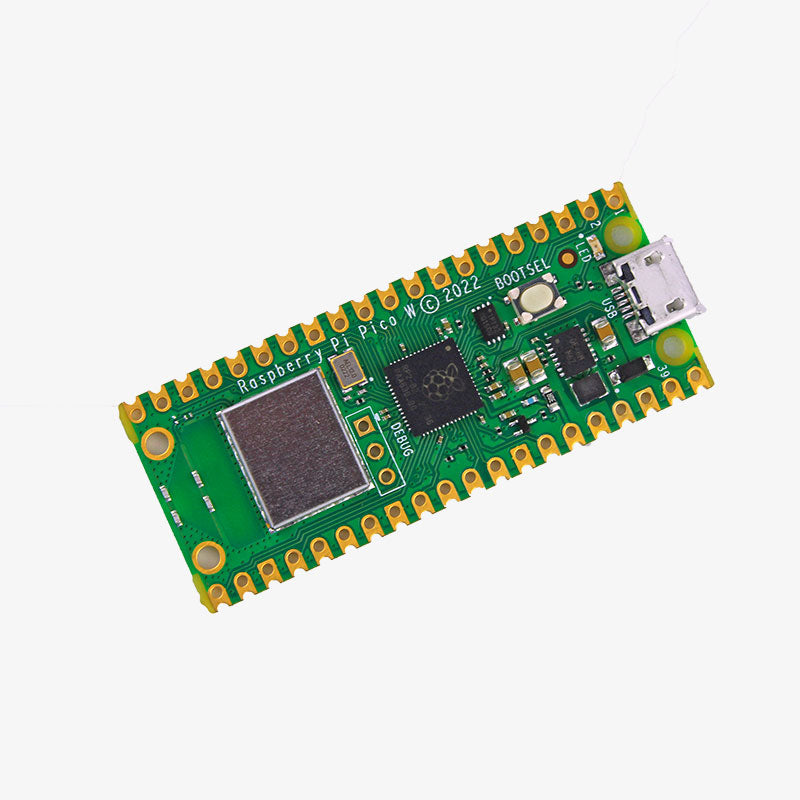
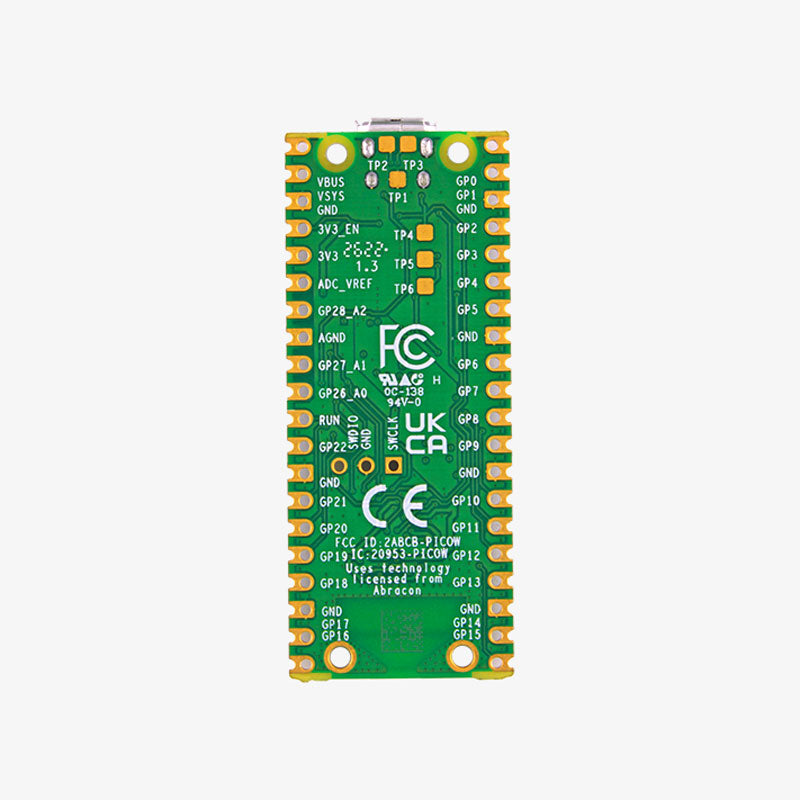
The Raspberry Pi Pico W combines the flexible RP2040 microcontroller platform with built-in wireless connectivity in a compact development board. It features a dual-core Arm Cortex-M0+ processor running at up to 133 MHz, 264KB of on-chip SRAM and 2MB of onboard flash memory.
For wireless projects, Pico W integrates the Infineon CYW43439 wireless chip, providing single-band 2.4GHz 802.11n Wi-Fi and Bluetooth 5.2 connectivity. Bluetooth supports both Bluetooth Classic and Bluetooth Low Energy (BLE).
The board provides 26 multifunction 3.3V GPIO pins, including three 12-bit ADC inputs, along with two SPI controllers, two I²C controllers, two UARTs and 16 PWM channels. Its eight programmable I/O (PIO) state machines provide additional flexibility for creating custom high-speed peripheral interfaces.
Pico W can be programmed using the Raspberry Pi Pico SDK and supported programming environments such as MicroPython, making it suitable for both conventional embedded development and Python-based learning.
Its compact 21 × 51 mm form factor, USB connectivity and wireless capability make it suitable for connected electronics, sensor networks, automation, data logging and IoT prototypes.
Technical Specifications
| Specification | Details |
|---|---|
| Product Type | Wireless Microcontroller Development Board |
| Microcontroller | Raspberry Pi RP2040 |
| Processor | Dual-core Arm Cortex-M0+ |
| Maximum Clock Frequency | Up to 133 MHz |
| On-Chip SRAM | 264 KB |
| Onboard Flash | 2 MB QSPI Flash |
| Wireless Chip | Infineon CYW43439 |
| Wi-Fi | Single-band 2.4 GHz 802.11n |
| Bluetooth | Bluetooth 5.2 |
| Bluetooth Support | Bluetooth Classic and Bluetooth Low Energy (BLE) |
| GPIO | 26 multifunction GPIO pins |
| Analog Inputs | 3 × 12-bit ADC |
| UART | 2 × UART |
| SPI | 2 × SPI |
| I²C | 2 × I²C |
| PWM | 16 PWM channels |
| Programmable I/O | 8 PIO state machines |
| USB | USB 1.1 controller and PHY |
| Input Voltage | 1.8–5.5V DC |
| Logic Voltage | 3.3V |
| Board Dimensions | 21 × 51 mm |
| Debug Interface | 3-pin SWD |
| Board Form Factor | 40-pin DIP-style PCB with castellated edges |
| Header Pins | Not pre-soldered |
| Programming | Raspberry Pi Pico SDK, MicroPython and supported development tools |
| Wireless Antenna | Onboard antenna |
| Operating Temperature | -20°C to +70°C |
| Quantity | 1 board |
Technical Specification Pointer
RP2040 dual-core Arm Cortex-M0+ microcontroller, up to 133 MHz, 264KB SRAM, 2MB flash, 26 GPIOs, 3 ADC inputs, 2.4GHz 802.11n Wi-Fi, Bluetooth 5.2 and 8 programmable I/O state machines.
Key Features
- Original Raspberry Pi Pico W development board
- Dual-core RP2040 microcontroller with up to 133 MHz clock speed
- 264KB on-chip SRAM and 2MB onboard flash
- Built-in 2.4GHz 802.11n Wi-Fi
- Bluetooth 5.2 with Bluetooth Classic and BLE support
- 26 multifunction GPIO pins
- Three 12-bit ADC inputs
- Two SPI, two I²C and two UART interfaces
- 16 PWM channels
- Eight programmable PIO state machines
- USB 1.1 connectivity for programming, communication and supported USB applications
- Supports MicroPython and Raspberry Pi Pico SDK development
- Compact 21 × 51 mm board format
- Suitable for embedded systems and IoT development
Recommended Applications
- IoT sensor nodes
- Wireless environmental monitoring
- Home and laboratory automation
- Data logging
- Wireless control systems
- Embedded electronics
- LED and display projects
- Sensor interfacing
- Bluetooth-enabled projects
- Wi-Fi-enabled microcontroller projects
- Prototyping and product development
Educational Applications
- Microcontroller programming
- MicroPython learning
- Embedded systems education
- GPIO and sensor interfacing
- Wi-Fi and Bluetooth projects
- IoT fundamentals
- PWM and actuator control
- ADC-based sensor projects
- UART, SPI and I²C communication
- Programmable I/O experimentation
Project Possibilities
- Wi-Fi temperature and environmental monitor
- Wireless sensor node
- IoT data logger
- Bluetooth-controlled electronics
- Smart home prototype
- Web-controlled LED or actuator system
- Wireless automation controller
- Sensor dashboard
- Custom communication interface using PIO
- Network-connected STEM projects
Compatibility Notes
The Raspberry Pi Pico W can be developed using the Raspberry Pi Pico SDK and MicroPython. Its 3.3V GPIO interface should be considered when connecting external sensors, modules and peripherals. External components requiring different voltage levels may require appropriate level-shifting or interface circuitry.
The board is supplied without pre-soldered GPIO headers.
What’s Included
- 1 × Raspberry Pi Pico W Original Development Board
Important Notes
- This is a microcontroller development board, not a Raspberry Pi Linux-based single-board computer.
- GPIO operates at 3.3V logic.
- GPIO pins should not be connected directly to signals exceeding their applicable electrical limits.
- The standard Pico W version does not include pre-soldered GPIO headers.
- External sensors, displays, motors and other peripherals may require additional components or power supplies.
- Wireless performance depends on antenna placement, surrounding environment and network conditions.
- USB cable is not included unless specifically mentioned in the product package.
Product Summary
The Raspberry Pi Pico W is a compact wireless microcontroller platform built around the RP2040. With dual-core processing, 2MB flash, 26 GPIOs, multiple communication interfaces, programmable I/O, 2.4GHz Wi-Fi and Bluetooth 5.2, it provides a flexible platform for IoT, embedded electronics, wireless automation and STEM development.
Reviews
There are no reviews yet.