Build Robots That Can See, Hear, Connect & Respond
Traditional educational robots often rely on simple sensors such as ultrasonic, infrared, or light sensors to understand their surroundings. While these are excellent for learning the fundamentals of electronics and robotics, advanced projects require a different level of perception.
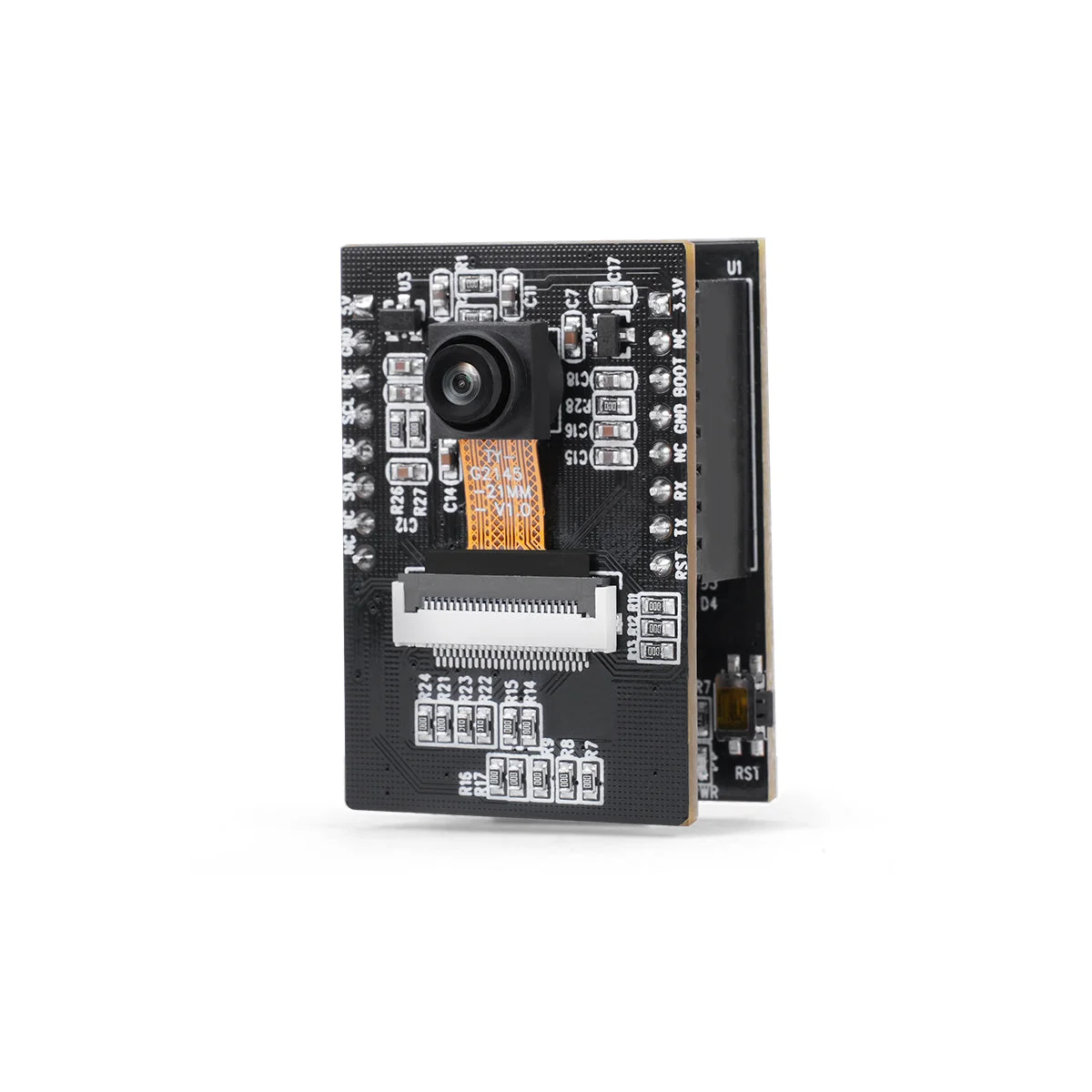
The ESP32-S3 AI Vision & Voice Camera Module provides a compact platform for taking that next step.
Built around the capable ESP32-S3 dual-core Xtensa® LX7 processor, this development module combines visual input, audio capabilities, wireless connectivity, and AI-oriented processing into a single hardware platform. This makes it suitable for students, educators, makers, and developers who want to explore the practical applications of Artificial Intelligence, Computer Vision, Edge Computing, IoT, and Human-Machine Interaction.
Instead of connecting a separate camera board, wireless module, and additional hardware for every experiment, this integrated platform provides a convenient starting point for developing intelligent prototypes.
From Camera Input to Intelligent Applications
The integrated camera can be used as the visual input for applications involving image capture, image processing, computer vision, object detection, and AI-assisted recognition, depending on the firmware and software framework being used.
This opens up a wide range of possibilities. Students can experiment with camera-based robotic navigation, visual monitoring, object recognition, and interactive machines. Developers can also use the board as a foundation for connected camera systems and edge-AI prototypes.
The ESP32-S3’s processing capabilities make it particularly interesting for educational AI projects where students need to understand how hardware, software, sensors, data, and machine-learning models work together.
Built for Connected IoT Projects
With built-in 2.4 GHz Wi-Fi and Bluetooth Low Energy (BLE) connectivity, the module can communicate with other devices and online services without requiring a separate wireless communication board.
This makes it suitable for connected projects such as smart monitoring systems, Wi-Fi cameras, IoT dashboards, intelligent home automation prototypes, and robots that exchange information with smartphones or cloud-based applications.
Developers can also experiment with sending captured data to external servers or AI services when required by the application.
Explore Voice & Human-Machine Interaction
The module also provides audio-related hardware capabilities, making it suitable for experimentation with voice commands, audio processing, speech-enabled devices, and interactive AI prototypes.
When combined with appropriate firmware, software libraries, speech-recognition services, or cloud APIs, students can explore concepts such as voice-controlled robotics and conversational interfaces.
For example, an educational robot could combine camera input with voice commands to create a more interactive human-machine experience.
A Powerful Platform for AI & STEM Education
For XR4STEM and PM Shri Lab environments, this module can serve as an advanced hardware platform for introducing students to the convergence of multiple modern technologies.
Students can progress from basic camera experiments to more advanced projects involving:
Embedded Systems → IoT → Computer Vision → AI/ML → Voice Interaction → Intelligent Robotics
This makes the module particularly suitable for advanced school projects, engineering prototypes, robotics competitions, maker laboratories, and higher-level STEM education.
Important: Specific AI capabilities such as object detection, facial recognition, speech recognition, generative-AI interaction, or ChatGPT integration depend on the firmware, software libraries, AI models, APIs, and processing architecture used with the module. These capabilities should not be considered guaranteed simply because the hardware is AI-capable.
Reviews
There are no reviews yet.