
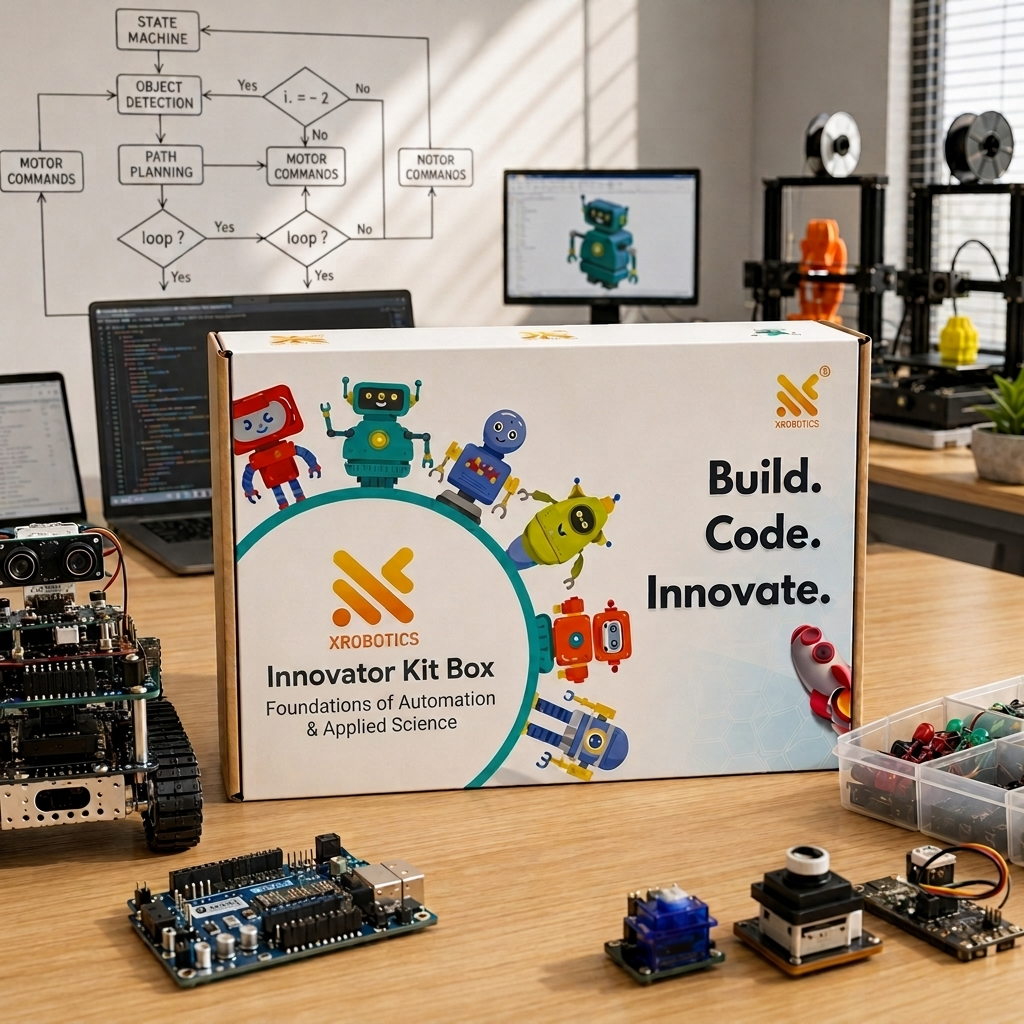
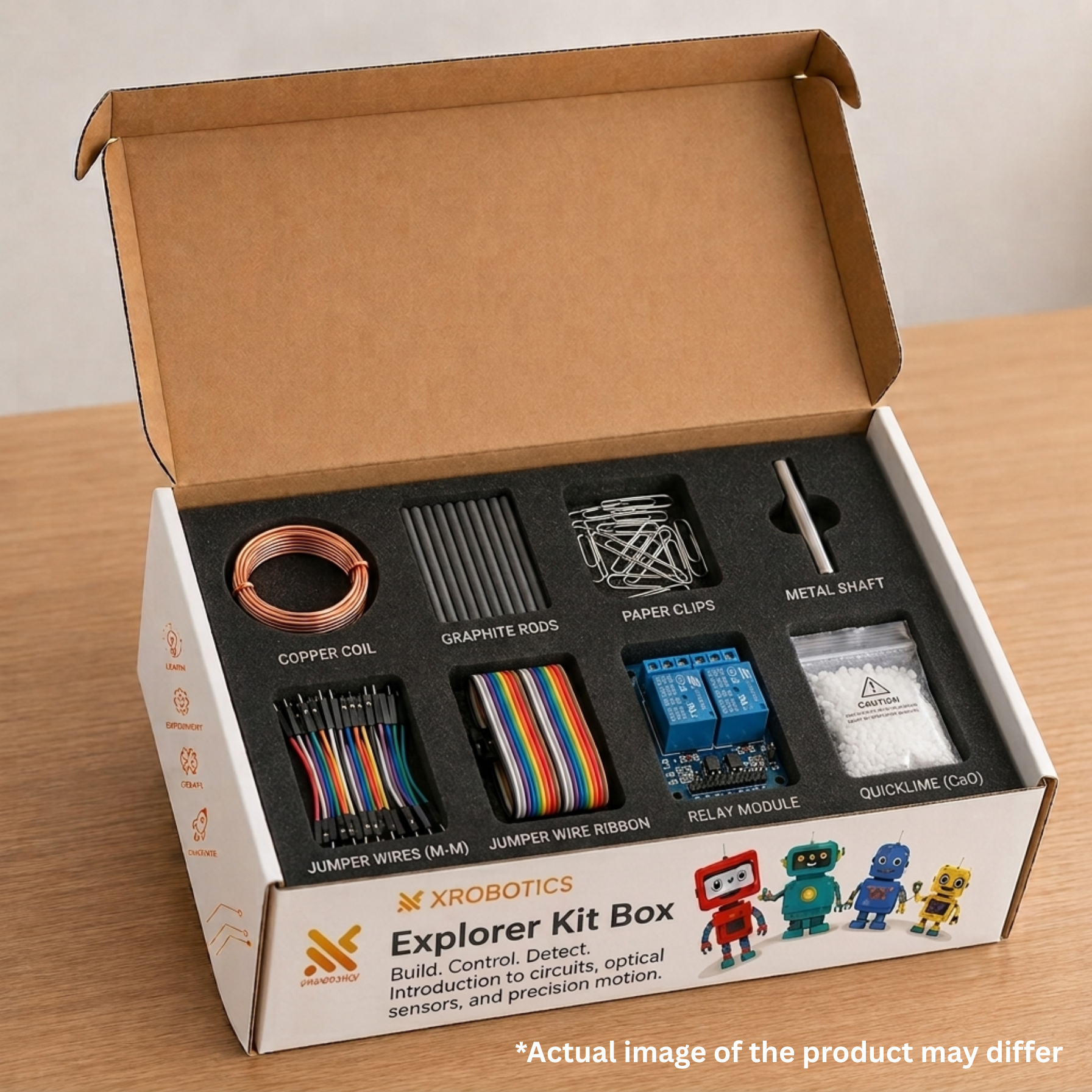
The Class 5 Innovator Kit: Foundations of Automation & Applied Science expands STEM learning from individual circuits and mechanical activities into applied science, automation and multidisciplinary project building.
Designed for Class 5 learners, the kit combines electronics, microcontroller-based control, sensors, mechanical systems, renewable energy and chemistry in one hands-on learning experience.
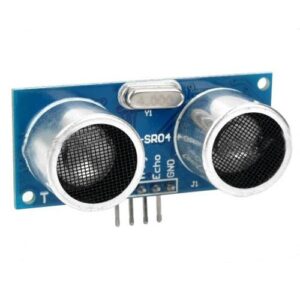
Students are introduced to an Arduino UNO SMD and learn how a microcontroller can interact with sensors and outputs. Activities involving IR and ultrasonic sensors, a 16×2 LCD, relay modules, LEDs, a buzzer and a water pump provide practical examples of sensing, control and automation.
The kit also extends beyond electronics. Students can build a hydraulic mechanical arm using syringes and tubing to explore fluid pressure and mechanical movement, investigate solar energy through solar-powered activities, and perform guided experiments demonstrating exothermic and endothermic reactions.
With 14 hands-on experiments and builds, the kit connects classroom science concepts with tangible working prototypes and provides a strong foundation for progressing toward programming, electronics, automation and engineering.
Technical Specifications
| Parameter | Specification |
|---|---|
| Product Type | Foundational STEM & Applied Science Learning Kit |
| Curriculum Level | Class 5 |
| Suggested Learner Age | 10+ years |
| Total Projects | 14 hands-on experiments and builds |
| Core Learning Areas | Applied physics, electronics, automation, renewable energy, hydraulics and chemistry |
| Microcontroller | Arduino UNO SMD Version |
| Display | 16×2 LCD |
| Sensors | IR sensor and ultrasonic sensor |
| Switching | 5V relay module |
| Pump | 5V water pump |
| Audio Output | 5V buzzer |
| Lighting Components | RGB LEDs and standard LEDs |
| Solar Component | Mini solar panel |
| Mechanical System | Hydraulic mechanical arm |
| Hydraulic Materials | Syringes and aquarium tubing |
| Motor | Toy motor |
| Prototyping Platform | Mini solderless breadboard |
| Wiring | Mixed jumper wires |
| Chemistry Materials | Quicklime (CaO), vinegar, soda and experiment containers |
| Learning Format | Hands-on project-based learning |
| Intended Use | Classroom learning, STEM workshops and guided project activities |
| Quantity | 1 kit |
Technical Specification Pointer
14-project Class 5 STEM kit combining Arduino-based automation, IR/ultrasonic sensing, LCD output, relay and pump control, solar energy, hydraulic mechanics and introductory chemical-reaction experiments.
Key Features
- Arduino-Based Automation: Introduces learners to microcontroller-based control using an Arduino UNO SMD.
- Sensor Integration: Uses IR and ultrasonic sensors to demonstrate how electronic systems can detect their surroundings.
- LCD Display Projects: Introduces visual output and displaying information from electronic systems.
- Relay & Pump Control: Demonstrates how a control circuit can operate an external electrical load such as a water pump.
- Automatic Water Dispenser: Provides a practical example of sensor-based automation.
- Hydraulic Mechanical Arm: Explores fluid pressure, force transmission and mechanical movement.
- Solar Energy Activities: Introduces renewable-energy concepts through solar-powered projects.
- Applied Chemistry: Includes activities demonstrating exothermic and endothermic reactions.
- Multidisciplinary Learning: Combines electronics, mechanics, physics, chemistry and renewable energy.
- 14 Hands-On Projects: Encourages students to learn through building, testing and observation.
Core Learning Areas
1. Electronics & Automation
Students explore:
- Arduino-based control
- Sensors and inputs
- Outputs and indicators
- Relay switching
- Pump control
- LCD displays
- Buzzer and LED outputs
- Basic automation logic
2. Applied Physics
Students explore:
- Electromagnetism
- Sound travel
- Ultrasonic sensing
- Fluid pressure
- Hydraulic movement
- Mechanical force transmission
3. Renewable Energy
Students explore:
- Solar energy
- Solar-powered systems
- Energy conversion
- Practical applications of renewable energy
4. Chemistry
Students explore:
- Exothermic reactions
- Endothermic reactions
- Observation-based chemical experiments
- Practical application of scientific concepts
Project Possibilities
The kit supports projects and activities including:
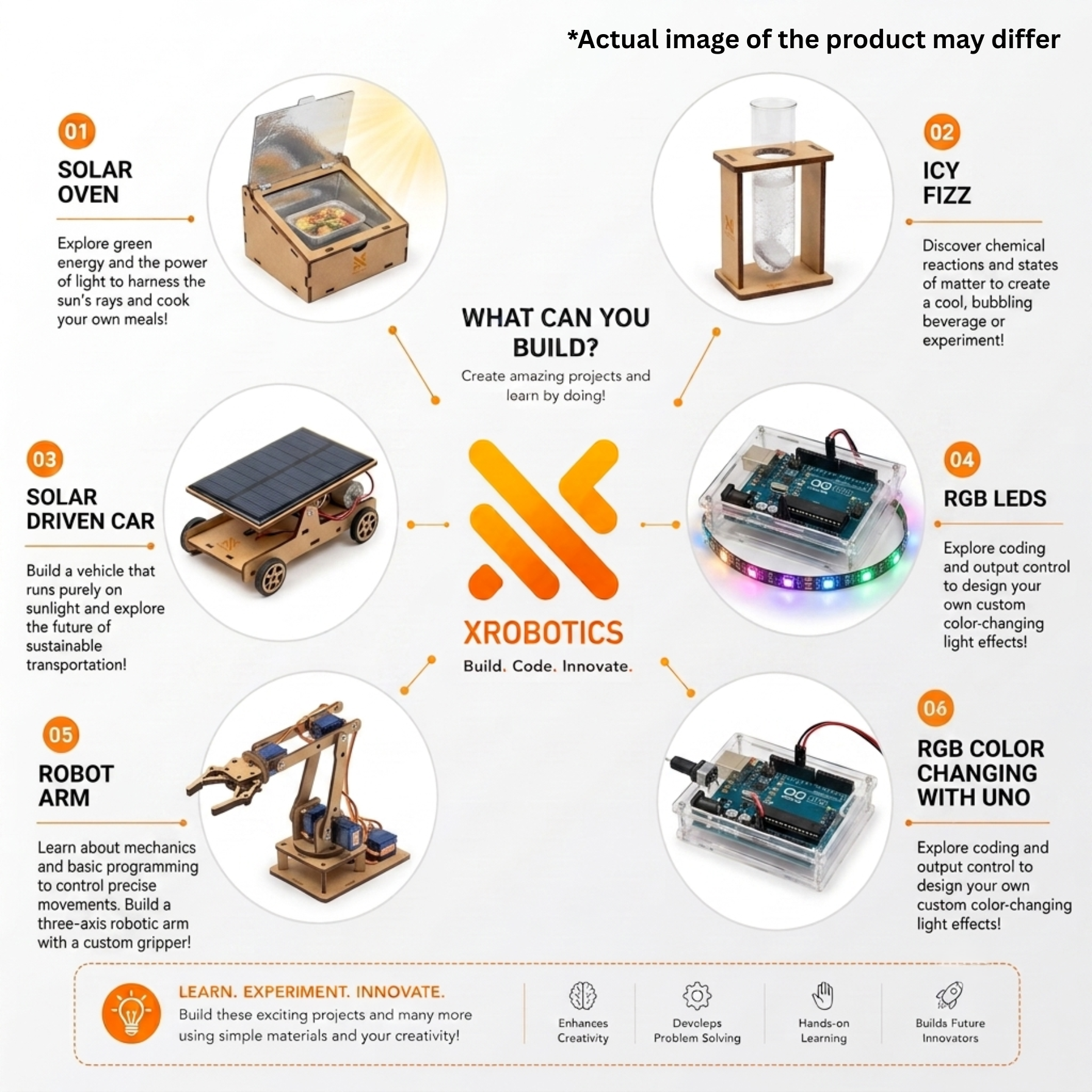
- Hydraulic Mechanical Arm
- Solar Oven
- Solar-Driven Car
- Automatic Water Dispenser
- Sensor-based automation
- Ultrasonic sensing experiments
- IR sensor projects
- LCD display experiments
- Relay-controlled output
- Water-pump control
- Sound and ultrasonic sensing activities
- Exothermic reaction experiment
- Endothermic reaction experiment
- Basic Arduino-controlled electronics
Recommended Applications
- Class 5 STEM learning
- Applied science classrooms
- School STEM workshops
- Science exhibitions
- Project-based learning
- Electronics introduction
- Arduino introduction
- Automation demonstrations
- Renewable-energy activities
- Mechanical engineering activities
- Guided science experiments
Educational Applications
This kit can be used to introduce learners to:
- Microcontrollers
- Sensor inputs
- Digital control
- Electronic outputs
- Relay switching
- Motor and pump control
- LCD displays
- Ultrasonic sensing
- Infrared sensing
- Hydraulic systems
- Solar energy
- Mechanical movement
- Energy conversion
- Chemical reactions
- Practical troubleshooting
- Systems thinking
What’s Included
Electronics
- Arduino UNO SMD Version
- Arduino cable
- 16×2 LCD display
- Ultrasonic sensor
- IR sensor
- 5V relay module
- 5V water pump
- 5V buzzer
- RGB LEDs
- Standard LEDs
- Mini breadboard
- 30 × mixed jumper wires
- Mini rocker switch
Mechanical & Project Materials
- Syringes – 6 pcs
- Aquarium pipe – 2 metres
- Mechanical arm cardboard template
- Toy motor
- Mini wheels
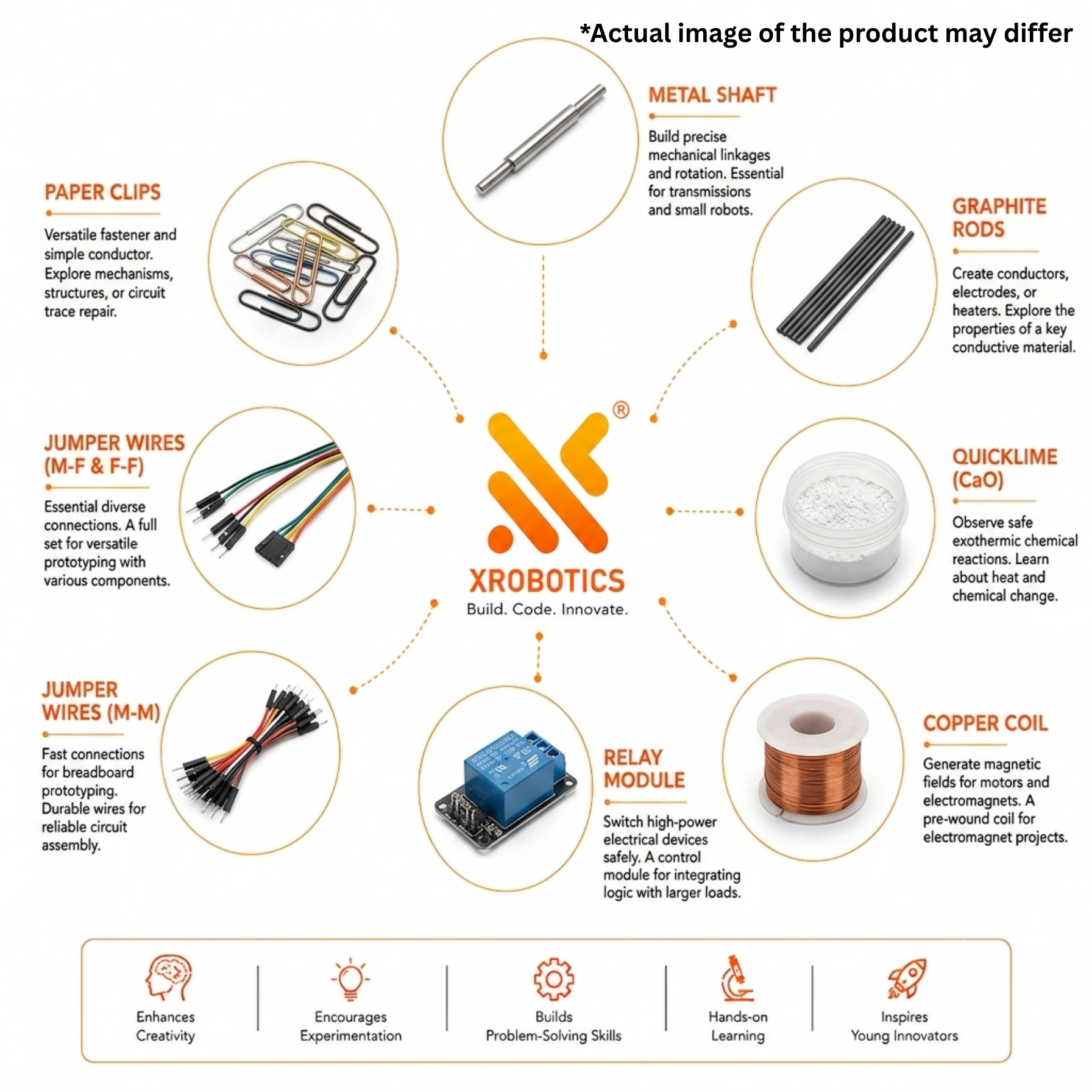
- Metal shaft
Science & Chemistry Materials
- Quicklime (CaO)
- Vinegar
- Soda
- Beaker
- Container
- Other activity materials required for the included projects
Renewable Energy
- Mini solar panel
Important Notes
- This is an educational STEM and applied-science learning kit, not an industrial automation system.
- Arduino projects require appropriate programming and circuit connections.
- Relay modules can switch electrical loads, but the connected load must remain within the applicable electrical ratings of the relay and power system.
- Sensor readings and detection performance depend on the environment, object position and project setup.
- Solar output varies with light conditions and is not a regulated power source by itself.
- Hydraulic activities depend on correct tubing, syringe and mechanical assembly.
- Chemistry activities should be performed according to the supplied instructions with appropriate adult/teacher supervision and suitable protective practices.
- Small components and electrical parts should be handled under appropriate supervision.
- Batteries, power supplies or additional components are not included unless specifically listed in the package contents.
Product Summary
The Class 5 Innovator Kit: Foundations of Automation & Applied Science is a multidisciplinary STEM kit that brings together Arduino, sensors, automation, hydraulics, renewable energy and applied chemistry. Through 14 hands-on projects, students progress from individual science concepts to integrated systems such as automatic water dispensing, sensor-based electronics, hydraulic mechanisms and solar-powered projects, creating a strong practical foundation for advanced electronics, programming and engineering.


Reviews
There are no reviews yet.