
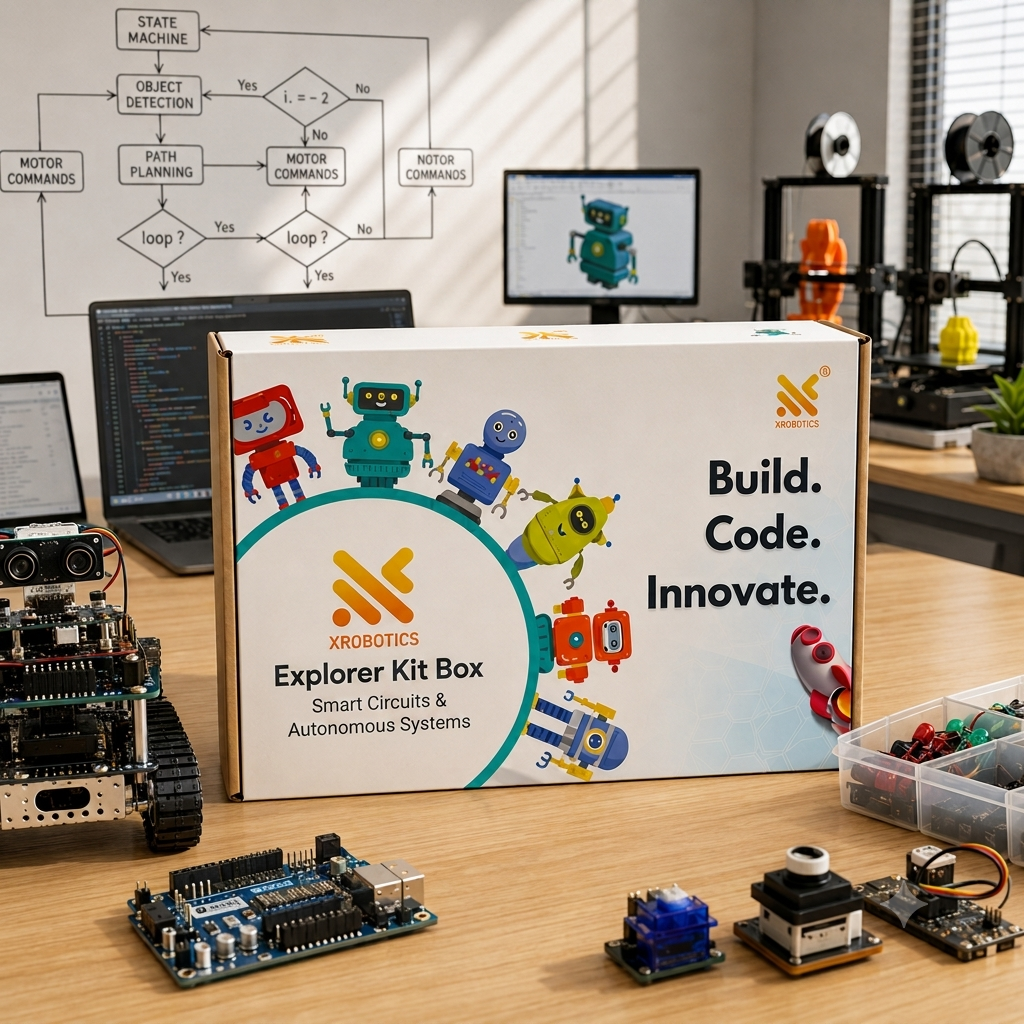
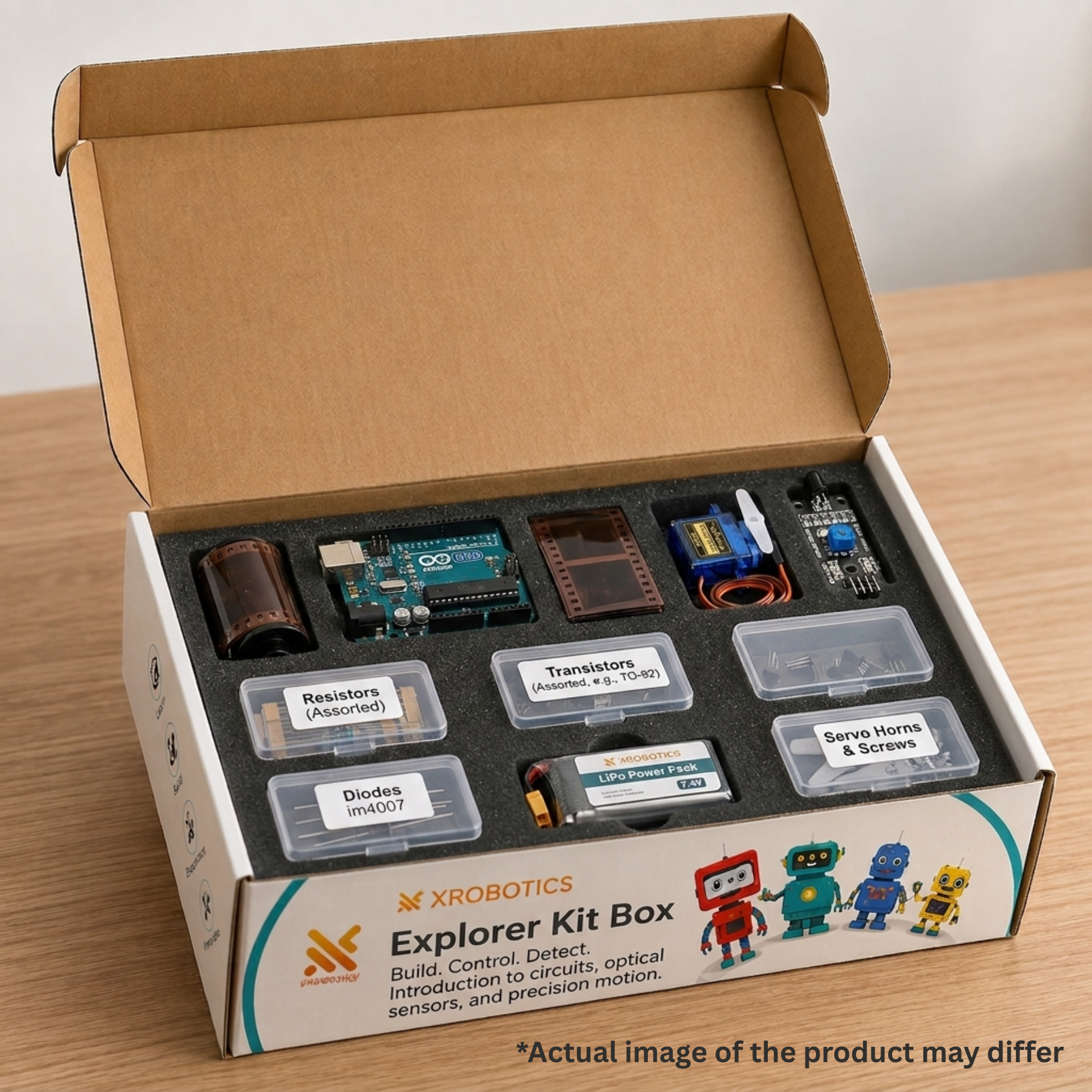
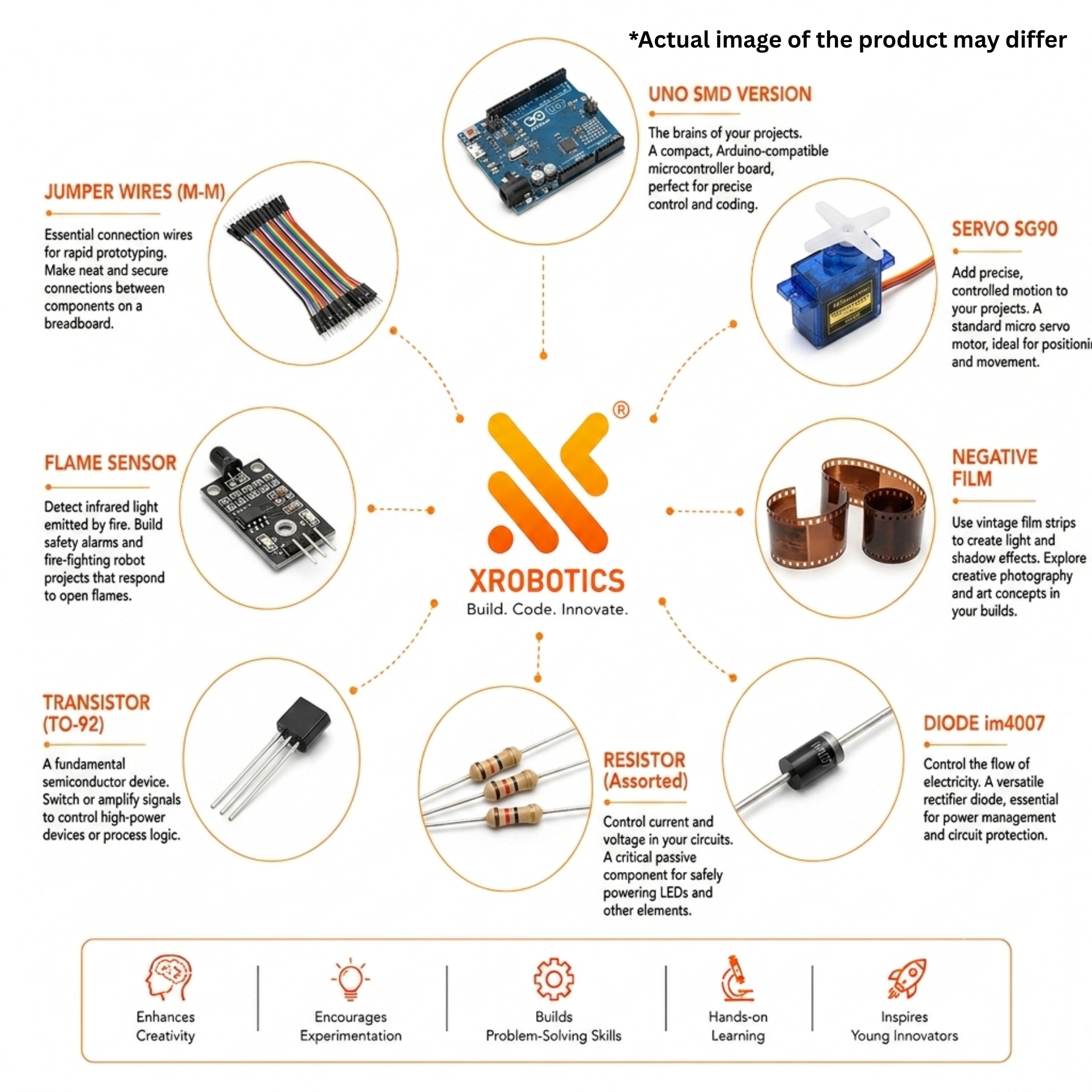
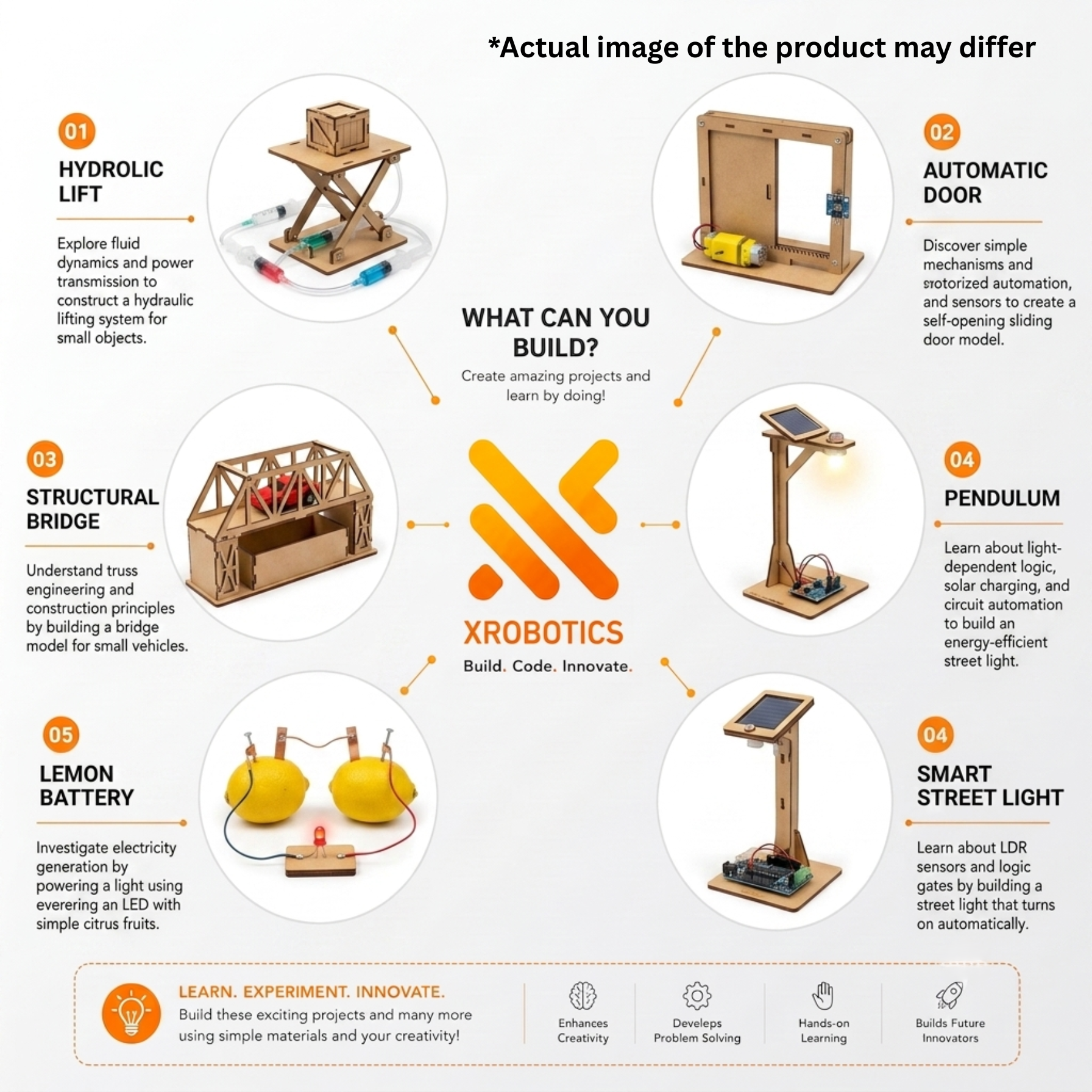
The Class 4 Explorer Kit: Smart Circuits & Autonomous Systems takes students from basic circuit building into the world of sensors, motor control and responsive machines.
Designed for Class 4 learners, the kit introduces an important engineering concept: a machine can sense its surroundings and respond to what it detects.
Students work with infrared (IR) sensors, motor drivers, BO geared motors and a 2WD robot chassis to explore how sensor signals can influence motor movement. Activities can introduce concepts such as obstacle detection, line tracking and sensor-based movement.
The kit also provides an introduction to breadboard-based circuit prototyping, allowing students to connect electronic components and experiment with different circuit arrangements.
By combining input → processing/decision → output concepts with physical movement, the kit creates a practical foundation for later learning in microcontrollers, programming, automation and robotics.
Technical Specifications
| Parameter | Specification |
|---|---|
| Product Type | Foundational STEM Learning Kit |
| Curriculum Level | Class 4 |
| Suggested Learner Age | 9+ years |
| Primary Learning Areas | Sensors, circuits, motor control and autonomous movement |
| Sensor Technology | Infrared (IR) sensing |
| Sensor Applications | Obstacle detection and line tracking |
| Motor System | BO geared DC motors |
| Drive Configuration | 2WD |
| Motor Driver | L293D motor driver |
| Chassis | 2WD robot chassis |
| Prototyping Platform | Mini solderless breadboard |
| Circuit Assembly | Breadboard-based electronic connections |
| Control Concept | Sensor input controlling motor response |
| Robot Activities | Obstacle detection and line-following concepts |
| Intended Use | Classroom learning, STEM workshops and guided project-based learning |
| Quantity | 1 kit |
Technical Specification Pointer
Class 4 sensor-based STEM kit combining IR sensing, L293D motor control, BO geared motors, a 2WD robot chassis and breadboard-based circuit prototyping for introductory autonomous movement.
Key Features
- Sensor-Based Learning: Introduces learners to using sensors as inputs for electronic systems.
- IR Obstacle Detection: Demonstrates how infrared sensing can be used to detect objects in a robot’s path.
- Line-Following Concepts: Introduces sensor-based detection of contrasting surfaces for guided robot movement.
- Motor Control: Students learn how a motor driver can control DC motors.
- 2WD Robot Platform: Provides a physical platform for experimenting with sensor-based movement.
- Breadboard Prototyping: Introduces temporary circuit construction without soldering.
- Input → Decision → Output: Helps learners understand how a machine can respond to information from its environment.
- Hands-On Systems Learning: Combines electronics, sensing and mechanical movement in one learning platform.
- Foundation for Programming: Provides a practical starting point for later microcontroller and coding projects.
Core Learning Areas
1. Sensors
Students explore:
- Infrared sensing
- Obstacle detection
- Surface/line detection
- Sensor signals as electronic inputs
2. Motor Control
Students learn:
- DC motor operation
- Direction and movement
- Motor-driver concepts
- Using an L293D motor driver with DC motors
3. Robot Movement
Students explore:
- Two-wheel-drive movement
- Forward and reverse movement
- Sensor-controlled responses
- Basic line-following concepts
- Obstacle-response concepts
4. Circuit Prototyping
Students practise:
- Breadboard connections
- Component interconnection
- Signal and power connections
- Testing and troubleshooting simple circuits
Project Possibilities
The kit can support projects such as:
- IR-based obstacle detection
- Basic obstacle-avoiding robot
- Line-following robot
- Sensor-controlled motor movement
- IR sensor demonstrations
- Motor-driver experiments
- Input-to-output circuit demonstrations
Recommended Applications
- Class 4 STEM learning
- Primary school electronics activities
- Sensor-based science projects
- STEM workshops
- Robotics introduction
- Classroom demonstrations
- Science and technology clubs
- Guided project-based learning
- Early embedded-systems education
Educational Applications
This kit can be used to introduce learners to:
- Sensors and electronic inputs
- Infrared sensing
- Motor drivers
- DC motors
- Robot chassis and drive systems
- Breadboard circuit building
- Signal-based control
- Obstacle detection
- Line tracking
- Basic automation
- Input → decision → output thinking
- Practical troubleshooting
What’s Included
1 × Class 4 Explorer STEM Learning Kit containing the sensor, motor-control, robot-platform and circuit-prototyping components required for the included activities.
Important Notes
- This is an educational STEM learning kit, not a professional autonomous-robot platform.
- Sensor performance depends on surface characteristics, object position, ambient conditions and circuit setup.
- Line-following performance depends on sensor alignment, track design and robot assembly.
- Motor behaviour depends on the power supply, motor load and mechanical assembly.
- Breadboard circuits require correct wiring and appropriate power connections.
- Small electronic and mechanical components should be used under appropriate adult/teacher supervision.
- The kit provides an introduction to autonomous movement; programmable behaviour requires a compatible controller and appropriate programming hardware/software where applicable.
- Batteries, controllers or additional components are not included unless specifically listed in the package contents.
Product Summary
The Class 4 Explorer Kit: Smart Circuits & Autonomous Systems introduces students to the next stage of hands-on STEM learning through IR sensors, breadboard circuits, motor drivers and a 2WD robot platform. By connecting sensor inputs with motor responses, learners begin to understand how machines can detect their surroundings and respond through movement—creating a practical foundation for future learning in microcontrollers, programming, automation and robotics.


Reviews
There are no reviews yet.