
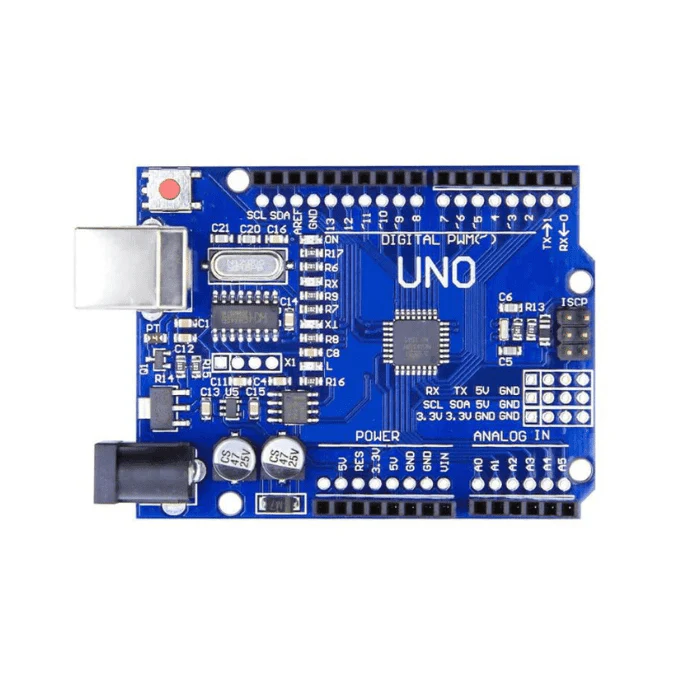
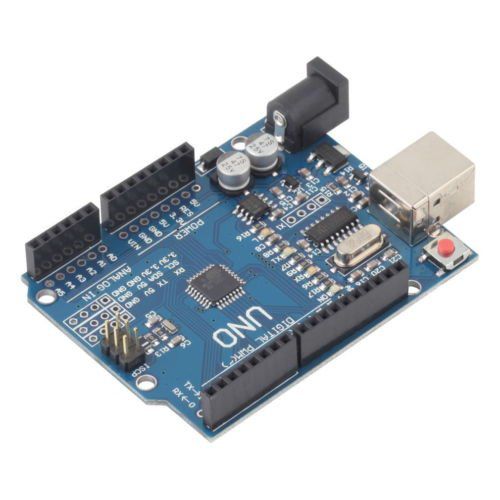
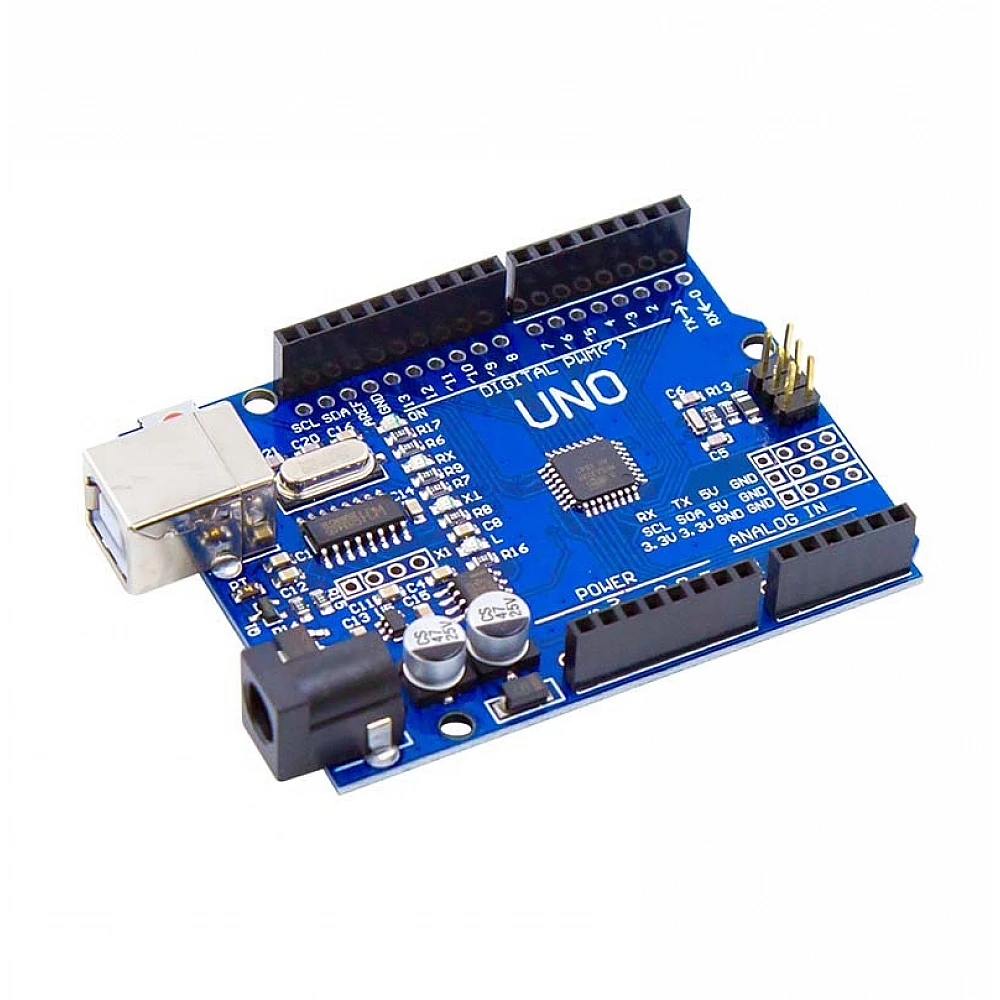
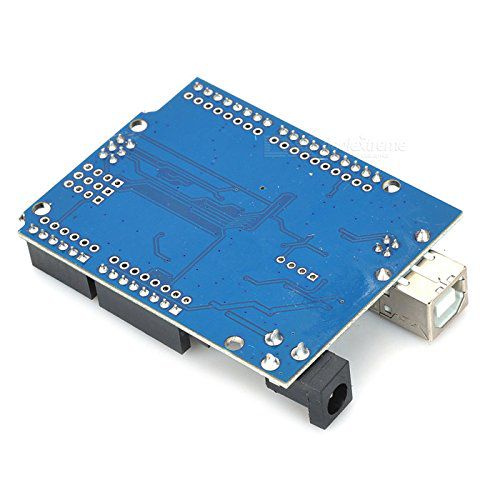
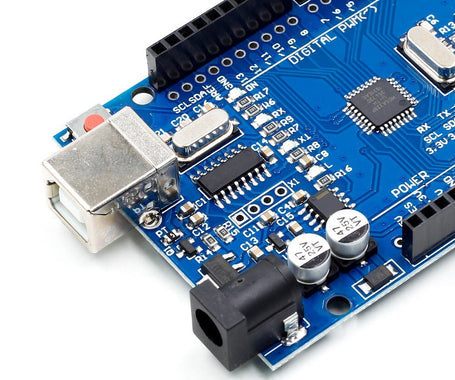
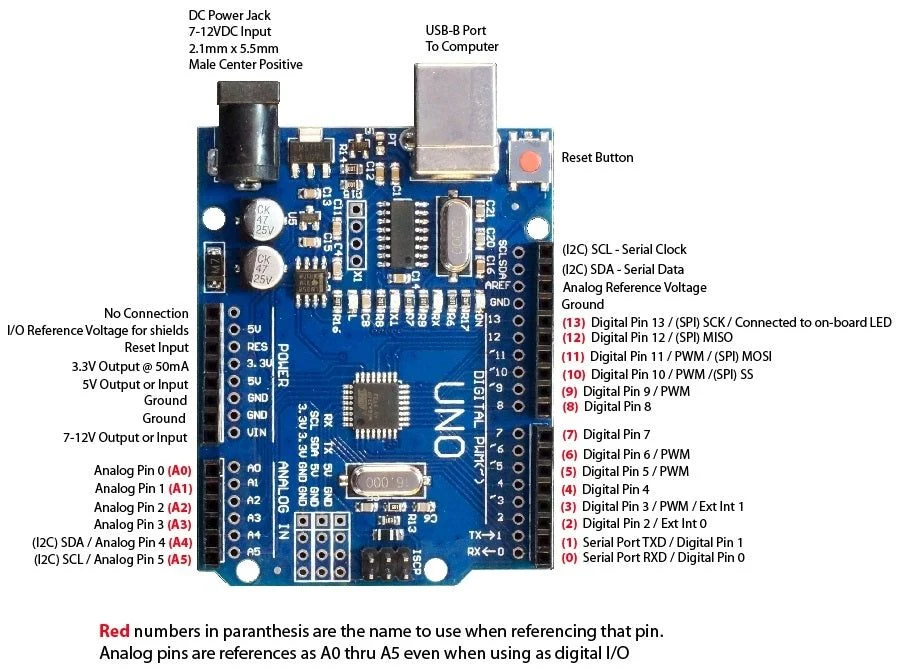
The Arduino UNO R3 SMD Compatible Development Board with CH340G is a practical microcontroller development board based on the ATmega328P in an SMD package. It follows the familiar UNO R3-style layout and provides the core I/O and memory resources commonly used for electronics and embedded-system projects.
The board provides 14 digital input/output pins, including 6 PWM-capable pins, along with 6 analog inputs. Its ATmega328P operates at 16 MHz and provides 32 KB of flash memory, 2 KB of SRAM, and 1 KB of EEPROM.
For computer connectivity and programming, the compatible board uses a CH340G USB-to-serial interface rather than the USB interface arrangement used on official Arduino UNO R3 boards. Depending on the operating system, the appropriate CH340 driver may be required for USB communication.
The SMD configuration mounts the main ATmega328P directly on the PCB instead of using the removable DIP-package microcontroller found on some UNO variants. This provides a compact board implementation while retaining the familiar UNO-style development approach.
The board is suitable for learning programming and electronics, reading sensor inputs, controlling LEDs and other low-power outputs, interfacing with displays and modules, and building embedded prototypes.
Note: This is an Arduino-compatible development board, not an official Arduino-branded board.
Technical Specifications
| Technical Parameter | Specification |
|---|---|
| Board Type | UNO R3-compatible development board |
| Microcontroller | ATmega328P |
| Microcontroller Package | SMD |
| USB-to-Serial Interface | CH340G |
| Operating Voltage | 5V |
| Recommended Input Voltage | 7–12V |
| Input Voltage Limit | 6–20V |
| Digital I/O Pins | 14 |
| PWM-Capable Digital Pins | 6 |
| Analog Input Pins | 6 |
| Analog Input Resolution | 10-bit |
| Clock Speed | 16 MHz |
| Flash Memory | 32 KB |
| Flash Used by Bootloader | 0.5 KB |
| SRAM | 2 KB |
| EEPROM | 1 KB |
| DC Current per I/O Pin | 40 mA maximum limit |
| 3.3V Pin Current | 50 mA |
| Programming / USB Interface | USB connection through CH340G |
| Additional Programming Interface | ICSP header |
| Power Options | USB or DC power input |
| Board Layout | UNO R3-style |
| Main Application | Microcontroller programming and embedded prototyping |
The core electrical and memory specifications above are supported by the supplied FlyRobo listing and cross-checking sources for the UNO R3 SMD CH340G configuration.
Technical Specification Pointer
ATmega328P + CH340G Architecture: The board combines an ATmega328P SMD microcontroller running at 16 MHz with a CH340G USB-to-serial interface, providing 14 digital I/O pins, 6 analog inputs, 6 PWM-capable outputs, 32 KB flash, 2 KB SRAM, and 1 KB EEPROM.
Key Features
- ATmega328P SMD Microcontroller: Provides the processing platform for Arduino-compatible embedded projects.
- CH340G USB-to-Serial Interface: Provides USB communication between the computer and the microcontroller.
- 14 Digital I/O Pins: Suitable for connecting digital sensors, switches, LEDs, displays, and other compatible peripherals.
- 6 PWM Outputs: Supports PWM-based control for compatible applications such as LED brightness and actuator control.
- 6 Analog Inputs: Allows the board to read analog signals from compatible sensors and circuits.
- 16 MHz Operation: Provides the standard clock speed associated with the UNO R3 platform.
- UNO R3-Style Layout: Designed around the familiar UNO form factor and pin arrangement.
- SMD Construction: Uses a surface-mounted ATmega328P rather than a DIP-package microcontroller.
- USB and DC Power Options: Can be powered/programmed through the available board interfaces.
Recommended Applications
- Arduino-compatible programming projects
- Electronics learning and experimentation
- Sensor-based projects
- IoT prototypes
- LED and display projects
- Embedded control systems
- DIY electronics
- Educational STEM projects
- Mobile robotics projects
- Home automation prototypes
Educational Applications
The board can be used to teach and demonstrate:
- Microcontroller programming
- Digital input and output
- Analog sensor interfacing
- PWM control
- Basic embedded systems
- Serial communication
- Sensor data acquisition
- LED and display control
- Introduction to automation and robotics
- Arduino-compatible programming concepts
Project Possibilities
The board can be incorporated into projects such as:
- Automatic lighting systems
- Temperature and environmental monitoring
- Sensor data logging
- Smart home prototypes
- Line-following and obstacle-detection projects
- Servo-controlled mechanisms
- LCD/OLED display projects
- Basic IoT prototypes
- Electronic control panels
- STEM demonstration models
What’s Included
- 1 × Arduino UNO R3 SMD Compatible Development Board
Important Notes
- This is an Arduino-compatible board, not an official Arduino-branded UNO R3.
- The board uses a CH340G USB-to-serial interface. The required CH340 driver may need to be installed depending on the computer and operating system.
- The ATmega328P operates at 5V on this board.
- The stated 7–12V input range refers to the recommended input range; the input limit should not be treated as a normal operating range.
- The 40 mA per I/O pin figure is a maximum electrical limit, not a recommended continuous operating current. Use appropriate current-limiting components and driver circuits for loads requiring significant current.
- Do not connect motors, relays, or other high-current loads directly to microcontroller I/O pins.
- Shield and accessory compatibility can depend on the specific hardware and electrical requirements of the connected accessory.
- USB cable and other accessories are not included unless specifically stated in the package contents.
Product Summary
The Arduino UNO R3 SMD Compatible Development Board with CH340G is a practical ATmega328P-based development board for electronics education, programming, sensor interfacing, and embedded prototyping. With 14 digital I/O pins, 6 analog inputs, 6 PWM outputs, 16 MHz operation, 32 KB flash, 2 KB SRAM, and 1 KB EEPROM, it provides the core capabilities required for a wide range of Arduino-compatible projects.


Reviews
There are no reviews yet.