
🎉 School Lab Bundles Now Live — 30-Student Sets from ₹1,49,999 | Use code SCHOOL10 for extra 10% off View Packages →

Sale!
,

5V 1-Channel Relay Module

Original price was: ₹ 75.00.Current price is: ₹ 55.00.

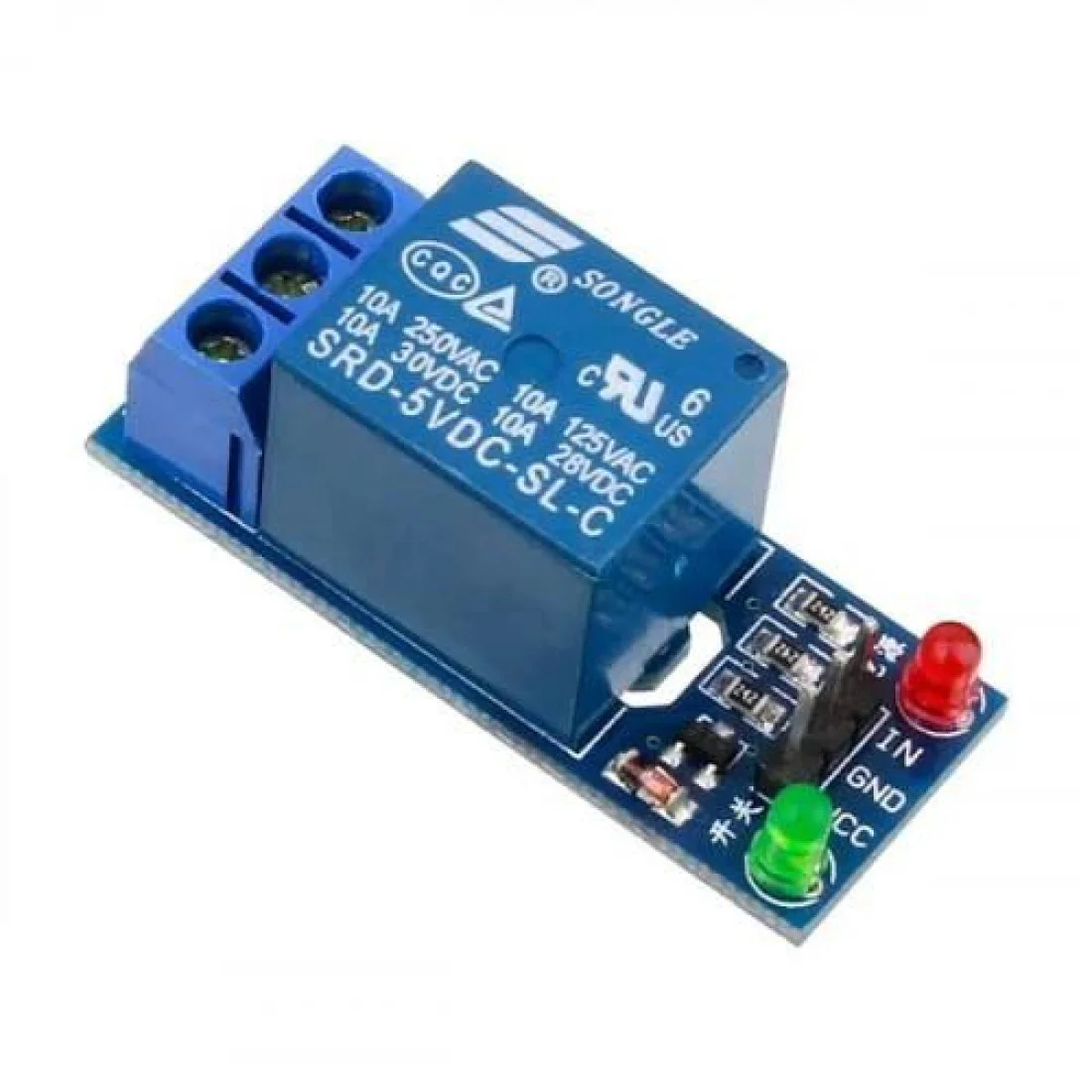
Control a higher-power electrical load using a low-voltage control signal. This 5V 1-Channel Electromechanical Relay Module is designed for Arduino, robotics, IoT, and automation projects, providing a convenient interface between a microcontroller and a separately powered AC or DC load.

Switch Real-World Loads with a Microcontroller

A microcontroller such as an Arduino can make decisions, read sensors, and execute programs—but its GPIO pins are designed for low-power control signals, not for directly switching high-power electrical loads.

The 5V 1-Channel Relay Module provides a practical interface between a microcontroller and an external electrical load.

When the control input activates the relay, an internal electromagnetic mechanism changes the state of the relay contacts. This allows the connected load circuit to be switched independently of the low-voltage control signal.

The module is useful for projects involving lights, small pumps, fans, solenoids, motors, alarms, and other compatible AC or DC loads, provided that the load remains within the relay’s rated electrical limits and the complete installation is appropriately designed.

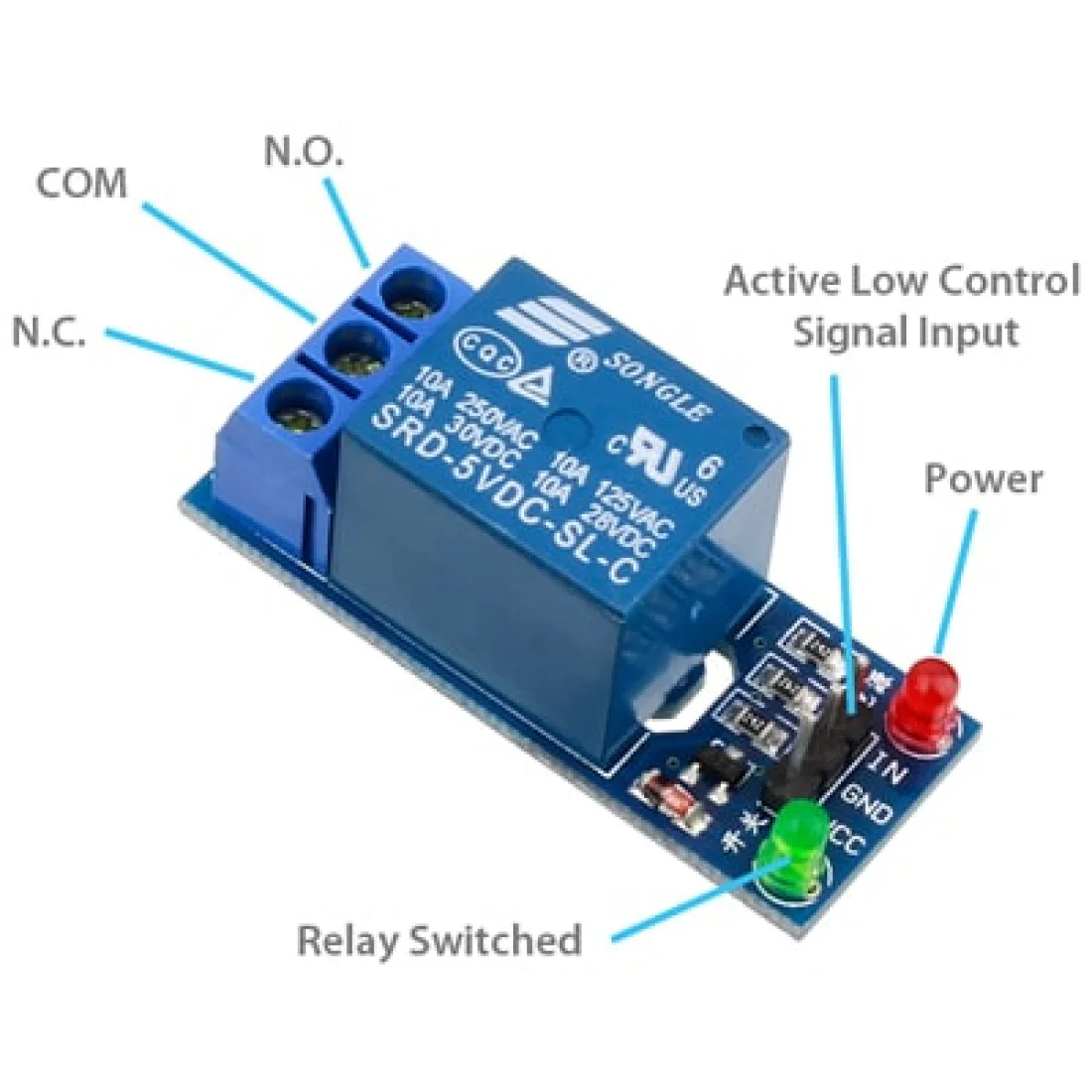
The relay provides COM (Common), NO (Normally Open), and NC (Normally Closed) contacts, giving you flexibility in deciding how the load behaves when the relay is not energized.

For students, makers, and robotics learners, it is an excellent component for understanding switching, automation, electrical control, and the relationship between low-voltage electronics and external power systems.
PERFECT FOR

• Arduino automation projects
• IoT switching projects
• Smart lighting prototypes
• DC pump control
• Fan control
• Solenoid control
• Robotics projects
• Automated irrigation systems
• Security and alarm prototypes
• STEM electronics experiments
• Embedded control systems
• DIY home-automation prototypes

HOW THE RELAY WORKS

The module contains an electromechanical relay controlled by a low-voltage input circuit.

When the relay is activated:

COM changes its connection from NC to NO.

This allows the relay to function as an electrically controlled switch.

The microcontroller does not need to directly supply the power required by the external load. Instead, it provides the control signal while the load receives power from its own appropriate supply circuit.

TECHNICAL SPECIFICATIONS

Component Type: 1-Channel Electromechanical Relay Module

Module Supply Voltage: 5V DC

Number of Channels: 1

Relay Contact Configuration: SPDT

Output Contacts: COM, NO, NC

Relay Contact Rating: Up to 10A @ 250V AC / 10A @ 30V DC, where applicable to the installed relay

Control Interface: VCC, GND, IN

Mounting: PCB Mount

Application: Switching compatible AC or DC loads using a low-voltage control signal

Suitable Platforms: Arduino and other compatible microcontroller/development boards

IMPORTANT: TRIGGER LOGIC

The exact trigger logic can vary between relay-module versions.

Some commonly available 5V relay modules use active-LOW triggering, while other versions may use different input circuitry.

Therefore, verify the trigger behaviour of the supplied module before integrating it into your program.

If your exact module is confirmed to be active-LOW, the relay is activated by pulling the IN pin LOW.

PRODUCT HIGHLIGHTS

⚡ 5V Control Interface

Control a relay using a low-voltage electronic signal from a compatible microcontroller.

🔌 One Independent Relay Channel

Switch one external load using the COM, NO, and NC contacts.

🔄 NO / NC Switching

Choose whether the load is normally connected or normally disconnected when the relay is inactive.

💡 Onboard Status Indicators

Many versions include power and relay-status LEDs for easier circuit debugging. Exact LED colour and behaviour may vary by module version.

🤖 Ideal for Arduino & Robotics

Useful for automation, robotics, IoT, and embedded electronics projects.

🏠 Home-Automation Prototyping

Suitable for educational demonstrations involving lights, fans, pumps, alarms, and other compatible loads.

SWITCHING CAPACITY

For relay versions using the commonly supplied 10A-rated relay, the relay contacts may be rated up to:

AC: 250V AC / 10A

DC: 30V DC / 10A

These figures represent the relay contact rating and should not be interpreted as a recommendation to operate any arbitrary appliance at the maximum rating.

Actual permissible load depends on factors such as:

• Load type
• Inrush current
• AC or DC operation
• Motor characteristics
• Switching frequency
• Wiring
• Relay/contact specifications
• Enclosure and installation conditions

IMPORTANT SAFETY INFORMATION

⚠️ This module can be used to switch hazardous voltages.

Working with mains electricity such as 220–240V AC can result in electric shock, fire, serious injury, or death.

Do not connect mains-powered appliances to this module unless the installation is performed by a suitably qualified person and all applicable electrical safety requirements are followed.

For student and classroom projects, use low-voltage DC loads whenever possible.

For educational demonstrations, suitable low-voltage loads such as small DC lamps, buzzers, fans, or pumps are generally preferable to exposed mains wiring.

IMPORTANT ISOLATION INFORMATION

Do not assume that every generic relay module provides full galvanic isolation between the control circuitry and the load side.

Some versions include an optocoupler, while others do not.

If your supplied module includes an optocoupler, the product specification should explicitly identify the relevant isolation arrangement.

Regardless of the relay type, appropriate PCB spacing, wiring, enclosure, grounding, and installation practices are still required when switching hazardous voltages.

COMPATIBILITY

This module is commonly used with:

• Arduino UNO
• Arduino Nano
• Compatible 5V microcontroller boards
• Robotics controllers
• IoT development boards
• Educational electronics platforms

Compatibility depends on the module's input circuit and trigger requirements.

For 3.3V development boards such as ESP32 or some NodeMCU variants, verify that the specific relay module recognizes the board's GPIO voltage correctly before connecting it directly.

COMMON APPLICATIONS

Smart Lighting

Use a relay to switch a compatible light circuit based on a sensor reading or programmed schedule.

Automatic Irrigation

Use a relay to control a compatible DC water pump in an automated plant-watering system.

Robotics

Control pumps, fans, lights, solenoids, and other compatible external loads from a robotics controller.

IoT Automation

Combine sensors, a microcontroller, and the relay to create automated switching systems.

Security Systems

Use the relay as a control interface for compatible alarms, locks, or other low-voltage devices.

EDUCATIONAL APPLICATIONS

The relay module is particularly useful for teaching:

• Digital switching
• Electromagnetism
• Open and closed circuits
• Normally Open and Normally Closed contacts
• Electrical automation
• Microcontroller interfacing
• IoT control systems
• Basic control engineering
• Robotics electronics

PRODUCT SPECIFICATION NOTE

Because this is a generic relay module, PCB layout, relay manufacturer/model, trigger circuit, LED configuration, dimensions, terminal style, and isolation arrangement may vary between manufacturing batches.

The actual relay rating printed on the supplied module should always be treated as the primary reference.

Do not rely solely on the product-page rating when designing a safety-critical or mains-powered application.

PACKAGE CONTENTS

1 × 5V 1-Channel Relay Module

SAFETY NOTE

This product is intended for educational, hobby, prototyping, robotics, and automation applications.

Disconnect all power before modifying wiring.

Never exceed the voltage or current ratings of the relay contacts.

Use appropriate fuses, wiring, connectors, insulation, and protective enclosures for the intended application.

Mains-voltage applications should only be installed and tested by appropriately qualified personnel.

IDEAL FOR

Students, Schools, STEM Labs, Robotics Learners, Arduino Users, IoT Developers, Makers, Electronics Hobbyists, Engineering Projects, Automation Prototyping

Reviews

There are no reviews yet.

Be the first to review “5V 1-Channel Relay Module”

Your email address will not be published. Required fields are marked *

Scroll to Top