
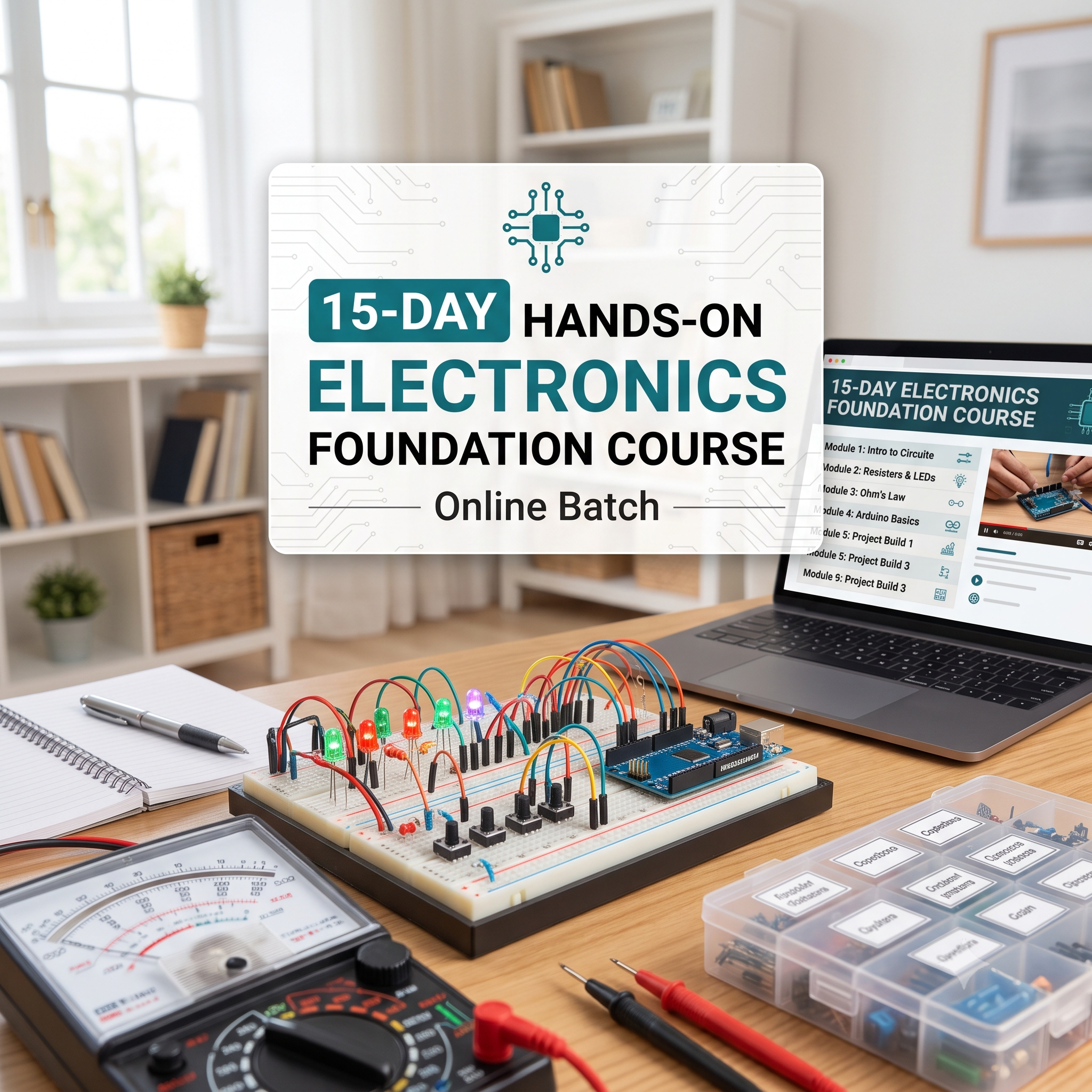
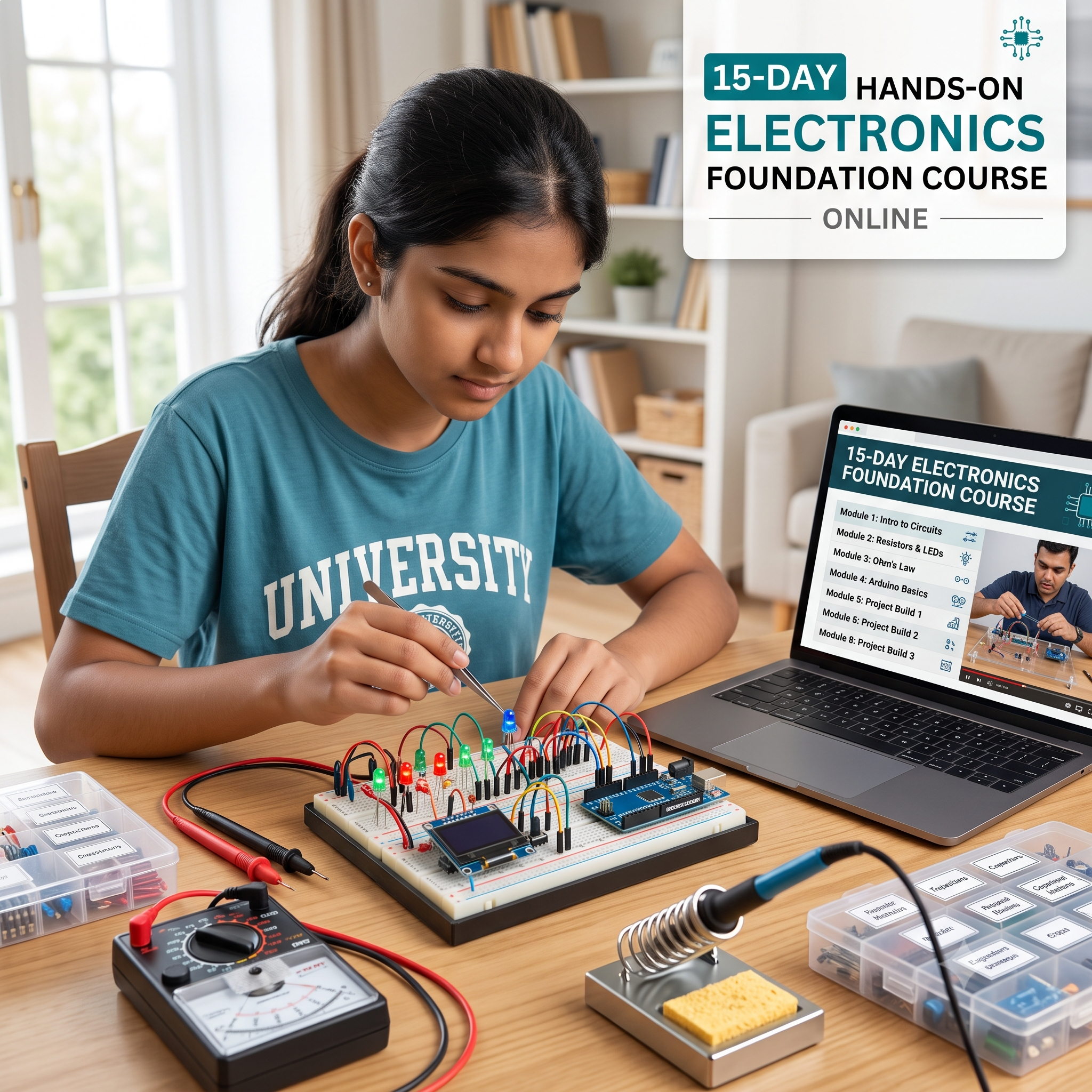
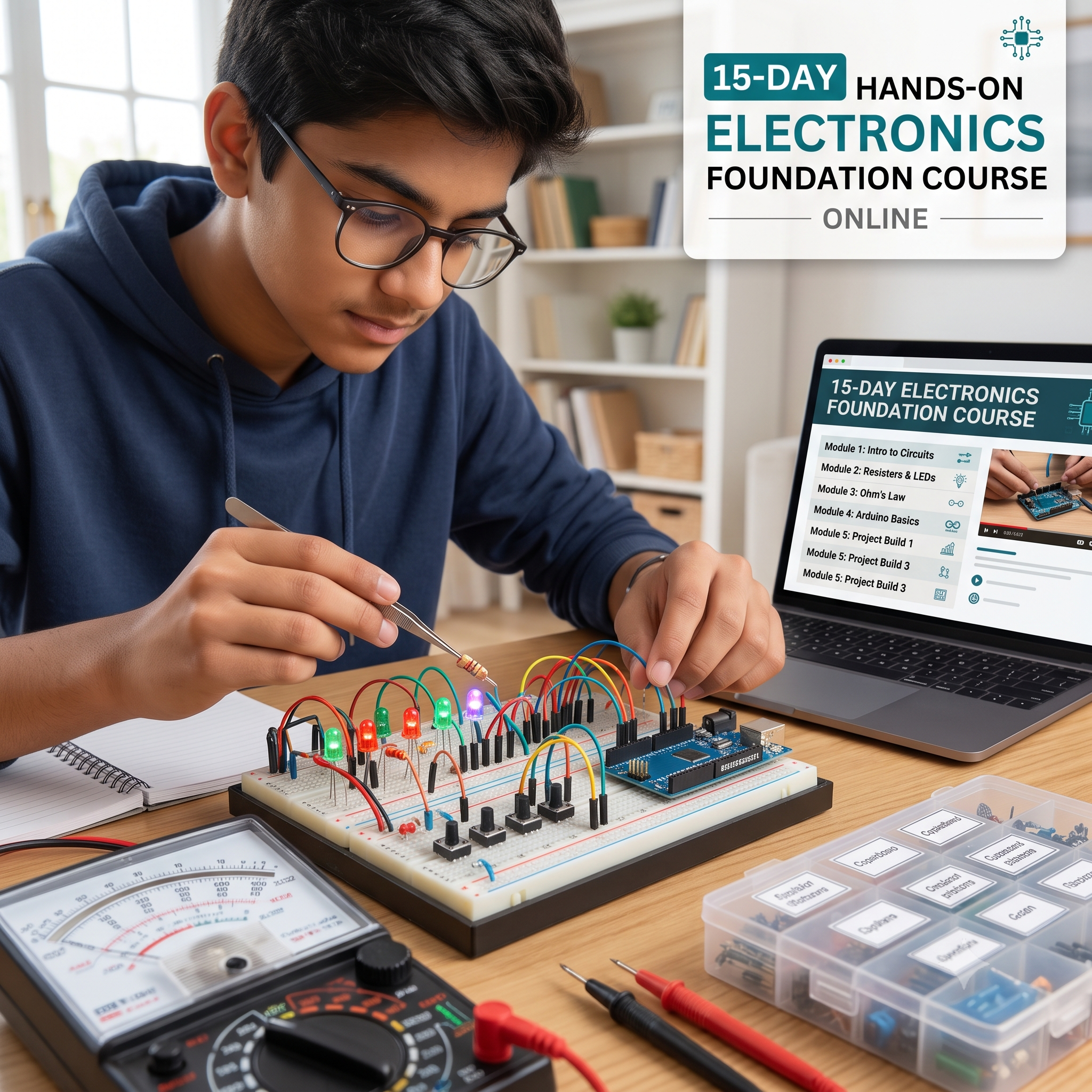
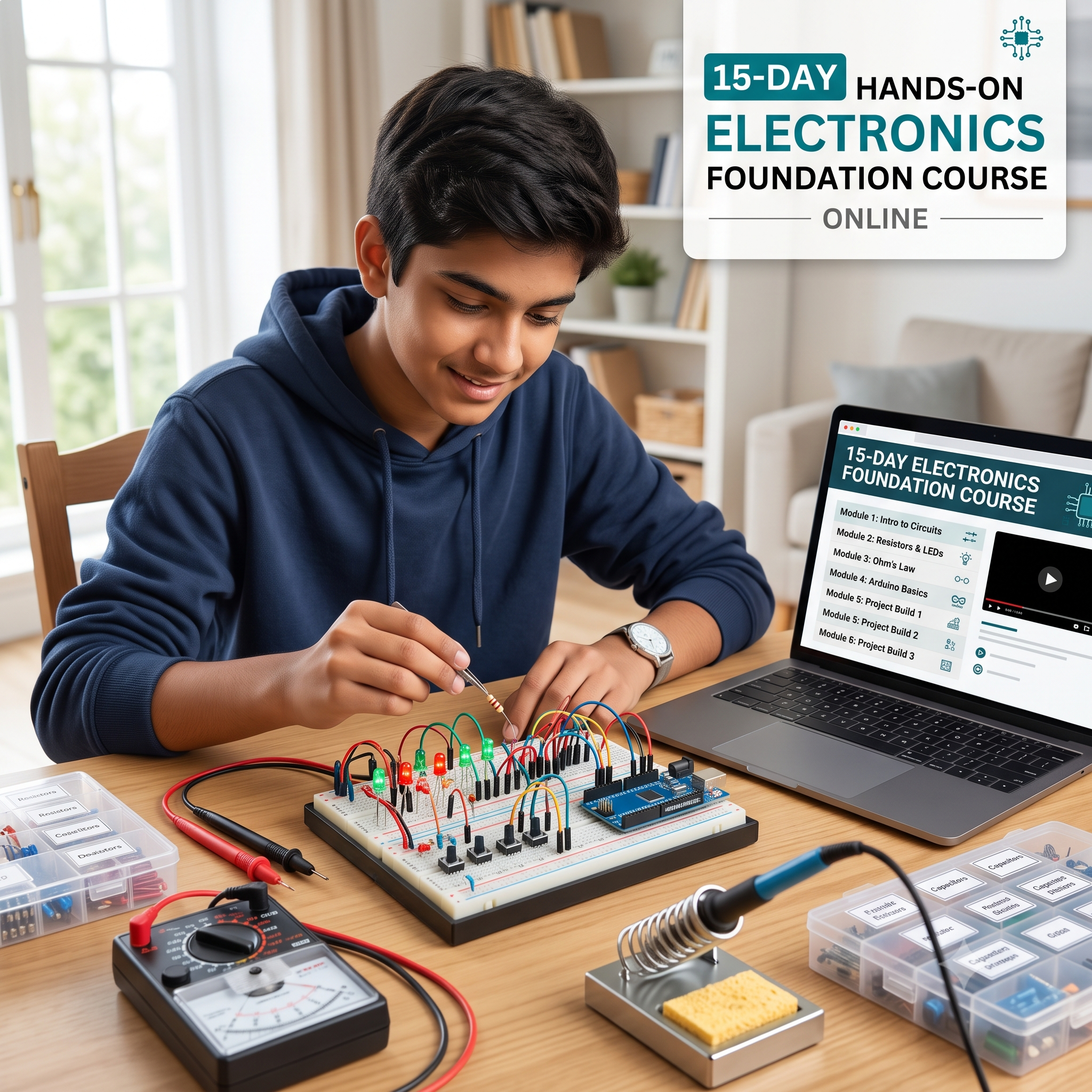
The 15-Day Hands-On Electronics Foundation Course – Online Batch is designed to help beginners develop a practical understanding of electronics through live online instruction combined with hands-on activities performed by the learners themselves.
The course starts with the fundamentals of electricity and electronic circuits, helping learners understand concepts such as voltage, current, resistance, Ohm’s Law, circuit connections, and power.
Learners then progressively work with common electronic components and practical circuits to understand how individual components behave and how they work together within an electronic system.
Through instructor-guided online sessions and practical activities, learners gain exposure to resistors, LEDs, switches, potentiometers, capacitors, transistors, diodes, relays, buzzers, sensors, Arduino Uno, breadboards, regulated power supplies, DC motors, and motor-control circuits.
The course also introduces measurement and troubleshooting using a digital multimeter, helping learners develop the habit of testing a circuit and identifying problems systematically.
As learners progress, the course introduces sensing, control, motor systems and practical automation concepts, providing a foundation for further learning in Arduino, embedded systems, IoT, automation and robotics.
The course follows a structured learning progression:
Electricity → Components → Circuits → Sensors → Control → Practical Projects
The objective is not simply to teach learners how to connect components, but to help them understand why a circuit works, how to test it, and how to troubleshoot it when it does not work as expected.
Technical Specifications
| Parameter | Specification |
|---|---|
| Program Type | Online Hands-On Electronics Training Program |
| Delivery Mode | Online Batch Class |
| Duration | 15 Days |
| Learning Level | Beginner / Foundation |
| Primary Focus | Basic Electronics & Circuit Building |
| Learning Method | Live instructor-guided online learning + learner-performed practical activities |
| Core Concepts | Electricity, components, circuits, sensing, control and testing |
| Practical Areas | Circuit Building, Sensors, Outputs, Switching, Motor Control and Troubleshooting |
| Controller Exposure | Arduino Uno |
| Prototyping Platform | Solderless Breadboard |
| Measurement Tool | Digital Multimeter |
| Sensor Exposure | LDR, NTC Thermistor and IR Sensor Module |
| Switching & Driver Exposure | Transistors, Diodes, Relay and L293D Motor Driver |
| Actuation Exposure | BO Geared DC Motors |
| Robotics Exposure | 2WD Robot Platform |
| Intended Users | Students, Beginners, Hobbyists and STEM Learners |
| Training Format | Online Batch |
| Practical Format | Instructor-guided hands-on activities |
15-day online batch program combining live instructor-guided learning with hands-on electronics activities covering components, circuits, sensors, switching, measurement, troubleshooting and introductory motor-control applications.
Course Objectives
The course is designed to help learners:
- Understand the fundamentals of electricity and electronic circuits.
- Learn the practical functions of commonly used electronic components.
- Build and test circuits using a breadboard.
- Understand resistor values and basic component selection.
- Work with LEDs, switches, potentiometers and capacitors.
- Understand basic transistor and diode applications.
- Explore sensors and electronic inputs.
- Understand basic relay and motor-control concepts.
- Gain introductory exposure to Arduino Uno.
- Use a digital multimeter for basic measurement and testing.
- Develop practical circuit troubleshooting skills.
- Understand how electronic inputs can be connected to controlled outputs.
- Build a foundation for further learning in embedded systems, IoT, automation and robotics.
Course Learning Areas
1. Electricity & Circuit Fundamentals
Learners begin with the basic principles required to understand electronic circuits.
Topics include:
- Voltage
- Current
- Resistance
- Ohm’s Law
- Basic circuit concepts
- Power and connections
- Circuit-building practices
- Basic electrical safety
2. Components & Circuit Building
Learners work with commonly used electronic components, including:
- Resistors
- LEDs
- Push buttons
- SPST and SPDT switches
- Slide switches
- Potentiometers
- Trimpots
- Capacitors
- Breadboards
- Jumper wires
The focus is on understanding component function and using them to construct practical circuits.
3. Sensors & Inputs
Learners are introduced to electronic sensing through practical activities involving:
- LDR
- NTC thermistor
- IR sensor module
- Sensor signals
- Threshold-based detection
- Input and output relationships
4. Transistors, Diodes & Switching
Learners explore basic electronic switching and control using:
- BC547 NPN transistor
- 2N2222 NPN transistor
- 1N4007 diode
- General-purpose signal diode
- 5V SPDT relay
5. Outputs & Indicators
Learners work with:
- Red LED
- Yellow LED
- Green LED
- Blue LED
- White LED
- Active buzzer
- Passive piezo buzzer
6. Measurement & Troubleshooting
Learners develop familiarity with:
- Digital multimeter use
- Checking circuit connections
- Measuring electrical parameters
- Identifying incorrect connections
- Testing circuit behaviour
- Finding common circuit problems
- Systematic troubleshooting
7. Arduino & Programmable Electronics
Learners gain introductory exposure to Arduino Uno and understand how programmable electronics can interact with inputs and outputs.
This provides a foundation for progressing toward:
- Arduino projects
- Embedded systems
- Automation
- IoT
- Sensor-based projects
8. Motor & Control Fundamentals
The course introduces basic motor-control concepts using:
- BO geared DC motors
- L293D motor-driver IC
- Motor wiring
- Motor power requirements
- Basic motor direction and control concepts
9. Practical Project Integration
As learners progress through the course, individual electronics concepts are connected into larger practical systems.
This introduces the relationship between:
Component → Circuit → Sensor → Control → Motor → System
Components & Tools Covered
Basic Electronics
- Arduino Uno
- 830-point breadboard
- 5V regulated power supply
- Male-to-Male jumper wires
- Male-to-Female jumper wires
- Female-to-Female jumper wires
- 220Ω resistor
- 330Ω resistor
- 470Ω resistor
- 620Ω resistor
- 1KΩ resistor
- 10KΩ resistor
- Other high-value resistors
- Red LED
- Yellow LED
- Green LED
- Blue LED
- White LED
- Tactile push button
- SPST switch
- SPDT switch
- Slide switch
- 10KΩ potentiometer
- Trimpot
Sensors & Outputs
- LDR
- NTC thermistor
- 3-pin IR sensor module with comparator
- Active buzzer
- Passive piezo buzzer
- 100µF electrolytic capacitor
- 220µF electrolytic capacitor
- 470µF electrolytic capacitor
- 100nF ceramic capacitor
- 1µF ceramic capacitor
- Timing capacitor assortment
Transistors & Drivers
- BC547 NPN transistor
- 2N2222 NPN transistor
- 1N4007 diode
- General-purpose signal diode
- 5V SPDT relay
- L293D motor-driver IC
Practical Robotics Exposure
- BO geared DC motor, dual shaft
- 2WD robot chassis
- Drive wheels
- Caster wheel
- Robot battery holder / battery pack
- Motor wires / connectors
- Mounting screws
- Spacers
- Brackets
- Cable ties / wire clips
Tools & Testing
- Digital multimeter
- Small screwdriver
Key Features
- 15-Day Online Batch: Structured electronics learning delivered through an online batch format.
- Hands-On Learning: Learners perform practical circuit activities alongside the online instruction.
- Live Instructor Guidance: Practical concepts and activities are explained and demonstrated during the training sessions.
- Component-Level Learning: Covers commonly used electronic components and their practical applications.
- Circuit Prototyping: Provides practical experience with breadboards, jumper wires and circuit connections.
- Sensor Exposure: Introduces learners to basic light, temperature and infrared sensing.
- Measurement & Testing: Develops practical familiarity with multimeter-based testing.
- Troubleshooting Skills: Encourages learners to identify and solve circuit problems systematically.
- Arduino Foundation: Introduces programmable electronics through Arduino Uno.
- Motor & Control Concepts: Provides exposure to relays, motor drivers and DC motor control.
- Project-Based Progression: Connects individual electronics concepts into practical systems.
Practical Skills Developed
Learners develop practical familiarity with:
- Identifying electronic components
- Understanding component values
- Reading basic circuit concepts
- Building breadboard circuits
- Connecting circuit power
- Using resistors and LEDs
- Working with switches and potentiometers
- Using capacitors
- Understanding transistor switching
- Understanding diode applications
- Working with relay circuits
- Interfacing basic sensors
- Using a digital multimeter
- Testing circuit connections
- Troubleshooting basic circuits
- Understanding motor-driver circuits
- Connecting and controlling DC motors
- Understanding the relationship between sensors, control and outputs
Recommended Applications
- Online STEM education
- Electronics foundation training
- Beginner electronics courses
- Online electronics workshops
- Arduino foundation programs
- Electronics project preparation
- Embedded systems foundation learning
- IoT foundation learning
- Automation foundation programs
- Robotics foundation programs
- Student skill development
Educational Applications
The course can be used to introduce learners to:
- Basic electrical concepts
- Electronic components
- Circuit construction
- Circuit measurement
- Sensor technology
- Analog and digital inputs
- Electronic switching
- Relay applications
- Motor-control concepts
- Microcontroller fundamentals
- Practical troubleshooting
- Hardware-based automation concepts
Project Possibilities
Depending on the practical activities and learner setup, learners can work toward projects involving:
- LED indicator circuits
- Switch-controlled circuits
- Sensor-based circuits
- Light-sensitive circuits
- Temperature-sensing experiments
- Buzzer-based alert systems
- Relay-controlled outputs
- Arduino-based input/output projects
- Motor-control experiments
- Basic automated systems
- 2WD mobile robot projects
Learning Journey
Electricity → Components → Circuits → Sensors → Control → Practical Projects
The course is designed so that learners first understand individual components and circuits before progressing toward systems that combine inputs, control and outputs.
This creates a foundation for future learning in:
Arduino → Embedded Systems → IoT → Automation → Robotics
Suitable For
- School students
- College students
- Beginners in electronics
- STEM learners
- Hobbyists
- Makers
- Aspiring engineers
- Students interested in Arduino
- Learners preparing for embedded systems
- Learners interested in IoT and automation
What’s Included
- 15-day online batch training
- Instructor-guided electronics lessons
- Practical circuit-building activities
- Component-level electronics activities
- Sensor and output activities
- Measurement and troubleshooting activities
- Arduino exposure
- Motor-control fundamentals
- Practical project activities
- Course learning guidance
Physical components and tools are not included unless specifically mentioned in the selected course package. Learners may need access to the required components and tools to perform the hands-on activities.
Important Notes
- This is an online batch-based training program.
- The course combines online instruction with practical activities performed by the learner.
- Learners should have access to the required components and basic tools for hands-on activities where applicable.
- The physical components listed under the course represent the practical learning areas covered by the program; they are not automatically included with the course fee.
- Practical activities may vary according to the course schedule, learner setup and instructional requirements.
- Learners should follow instructor guidance when working with powered circuits, batteries, motors and other electronic equipment.
- Arduino is introduced as part of the broader electronics learning pathway; electronics fundamentals remain the primary focus of the course.
- The course provides a foundation for further learning in embedded systems, IoT, automation and robotics.
Product Summary
The 15-Day Hands-On Electronics Foundation Course – Online Batch is designed to help beginners develop practical electronics skills from the ground up.
Through live online instruction and learner-performed hands-on activities, participants progress from electricity and basic components to circuit building, sensors, outputs, switching, measurement, troubleshooting, Arduino exposure and motor-control concepts.
The course focuses on understanding how and why circuits work, not simply following connection diagrams.
It provides a strong foundation for learners who want to continue into Arduino, embedded systems, IoT, automation and robotics.
Learn Electronics. Build Circuits. Test. Troubleshoot. Create.
XROBOTICS — Because practical learning builds real confidence.



Reviews
There are no reviews yet.