🎉 School Lab Bundles Now Live — 30-Student Sets from ₹1,49,999 | Use code SCHOOL10 for extra 10% off View Packages →

Sale!
,

NodeMCU ESP8266 V3 (CH340) Wi-Fi Development Board

Original price was: ₹ 350.00.Current price is: ₹ 220.00.

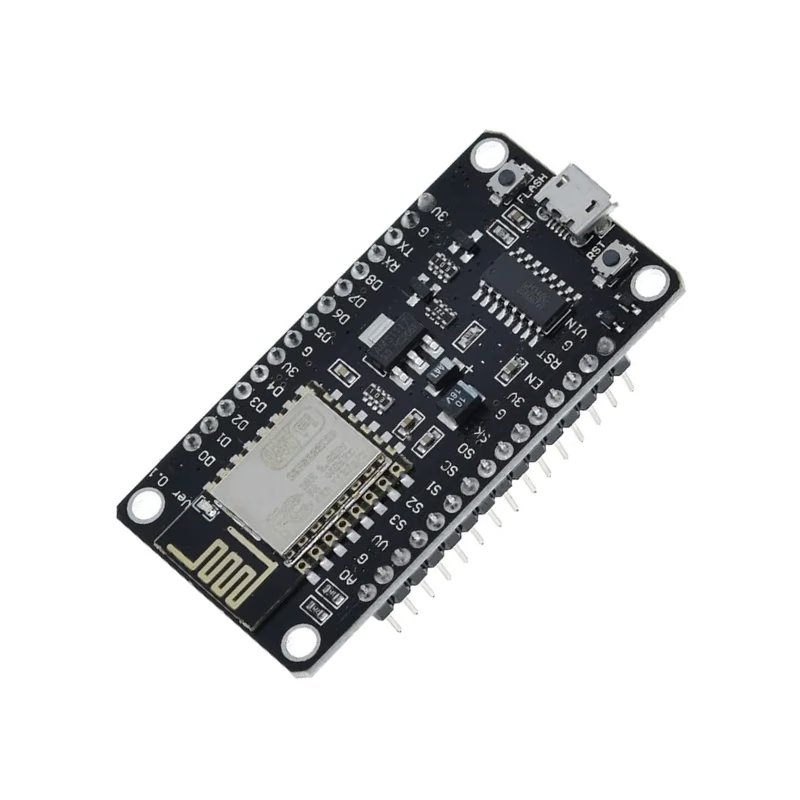
Bring Wi-Fi connectivity to your next electronics project. The NodeMCU ESP8266 V3 combines an ESP8266 Wi-Fi microcontroller, CH340 USB-to-serial interface, onboard 3.3V regulation, and breadboard-friendly GPIO in a compact development board—ideal for IoT, robotics, automation, sensor networks, and wireless prototypes.

A Simple Way Into Wi-Fi & IoT

The NodeMCU ESP8266 V3 (CH340) is a compact, affordable development board built around the ESP8266 32-bit Wi-Fi microcontroller. It combines wireless connectivity, programmable GPIO, analog input, USB programming, and power regulation on a single board, making it an excellent starting point for IoT and connected-electronics projects.

Unlike a conventional Arduino board that requires a separate wireless module for internet-connected applications, the ESP8266 provides built-in 2.4 GHz Wi-Fi with support for common wireless networking modes and TCP/IP connectivity. This makes the board suitable for projects that need to send sensor data, receive commands, host a simple web interface, or communicate with online and local IoT services.

The onboard CH340 USB-to-serial converter provides a convenient connection between the development board and a computer, allowing programs to be uploaded through its Micro-USB port. The board can be programmed using the Arduino IDE, NodeMCU/Lua firmware, and other supported development environments such as MicroPython and PlatformIO.

With its compact, breadboard-friendly design and multiple GPIO functions, the NodeMCU ESP8266 V3 is well suited to everything from classroom IoT experiments to smart-home prototypes, wireless sensor networks, automation systems, and connected robotics.

Perfect For

IoT projects
Smart-home automation
Wireless sensor networks
Remote monitoring
Smart agriculture
Weather monitoring
Wi-Fi-controlled robotics
Cloud-connected data logging
MQTT projects
Blynk-based prototypes
Web-server projects
Smart lighting
Remote relay control
STEM and electronics education

Technical Specifications

Specification Details
Board Type ESP8266 Wi-Fi Development Board
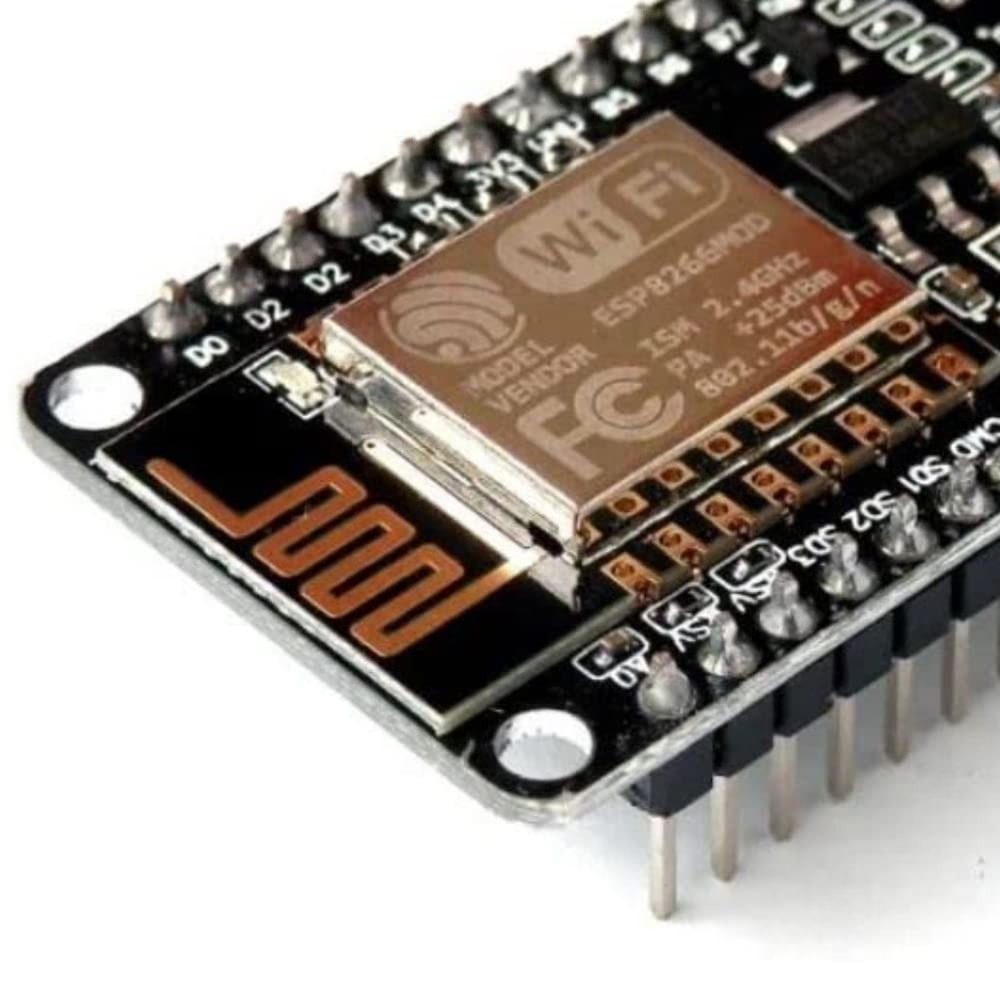
ESP8266 Module ESP-12E / ESP8266-based
Processor 32-bit Tensilica L106
Clock Speed 80 MHz; configurable up to 160 MHz
Flash Memory 4 MB
Wi-Fi Standard IEEE 802.11 b/g/n
Wi-Fi Frequency 2.4 GHz
USB-to-Serial CH340 / CH340G
Logic Voltage 3.3V
Digital GPIO 11 exposed digital I/O pins
Analog Input 1 × ADC (A0)
Communication UART, SPI, I²C, PWM
USB Connector Micro-USB
Programming Arduino IDE, NodeMCU/Lua, MicroPython, PlatformIO
Wireless Modes Station, Access Point, Station + AP
Form Factor Breadboard-friendly
Board Size Approx. 58 × 31 mm*

*Dimensions can vary slightly between V3/CH340 board manufacturers.

Key Features

Built-In 2.4 GHz Wi-Fi

The ESP8266 provides integrated 802.11 b/g/n Wi-Fi, allowing projects to connect to wireless networks without requiring a separate Wi-Fi module.

ESP8266 Processing

The ESP8266 uses a 32-bit Tensilica processor and typically operates at 80 MHz, with support for operation at up to 160 MHz depending on configuration and firmware.

4 MB Flash Memory

The commonly sold ESP-12E NodeMCU V3 boards provide 4 MB of flash memory, giving you space for firmware and IoT applications.

CH340 USB-to-Serial Interface

The onboard CH340 USB-to-serial converter makes programming and serial communication straightforward through the Micro-USB port.

Breadboard-Friendly Design

The compact board exposes its GPIO pins through standard header spacing, making it convenient for breadboard prototyping and classroom electronics projects.

Multiple Programming Options

The board can be used with:

Arduino IDE
NodeMCU firmware / Lua
MicroPython
PlatformIO

This flexibility makes it suitable for both beginner-friendly educational projects and more advanced IoT development.

GPIO & Interface Capabilities

The NodeMCU ESP8266 V3 provides multiple exposed GPIO pins that can be used for:

Digital input/output
PWM
UART
SPI
I²C
Interrupt-based applications
1-Wire devices

It also provides one analog input channel (A0) for reading analog sensor signals.

Important A0 Note

The ESP8266's native ADC has a 0–1.0V input range. Many NodeMCU development boards include an onboard voltage divider that allows a higher voltage to be measured at the board's A0 pin. Because the implementation can vary between board manufacturers and revisions, verify the A0 input range of the exact board supplied before connecting a sensor output.

Power & Voltage

The ESP8266 operates internally at 3.3V, and its GPIO logic is 3.3V.

The board can commonly be powered through its Micro-USB port, where the USB supply is regulated onboard for the ESP8266. Some V3/CH340 board versions also expose a VIN input with a specified voltage range.

Important: Because NodeMCU V3 boards are produced by multiple manufacturers, the exact VIN specification can differ. Check the markings/specification of the actual board before applying external voltage to VIN.

3.3V Logic — Important

Do not connect 5V logic directly to ESP8266 GPIO pins.

When connecting 5V sensors, displays, Arduino boards, or other peripherals, verify their signal voltage requirements and use an appropriate level-shifting solution where necessary.

Wi-Fi Capabilities

The ESP8266 supports 2.4 GHz 802.11 b/g/n Wi-Fi and can operate in different networking configurations, including:

Station Mode
Access Point Mode
Station + Access Point Mode

This allows you to build projects ranging from simple Wi-Fi sensor nodes to standalone web-controlled devices.

Note: ESP8266 does not support 5 GHz Wi-Fi.

Example Projects

Smart Weather Station

Connect temperature, humidity, pressure, or other environmental sensors and publish readings to a web dashboard or cloud service.

Smart Home Automation

Control compatible relay modules, lights, fans, and other low-voltage automation devices through a web interface or IoT platform.

Wireless Sensor Node

Create compact sensor nodes that transmit environmental measurements over Wi-Fi.

IoT Plant Monitor

Combine soil-moisture and environmental sensors with Wi-Fi connectivity to remotely monitor plant conditions.

Wi-Fi-Controlled Robot

Use the ESP8266 as the wireless communication controller for a small robot, while dedicated motor-driver hardware handles the motors.

MQTT Sensor System

Build lightweight connected devices that publish and receive messages using MQTT.

Web-Controlled Device

Create a simple web server hosted on the ESP8266 to control outputs or display sensor readings.

Educational Applications

The NodeMCU ESP8266 V3 is particularly useful for teaching:

Microcontroller programming
Wi-Fi communication
Internet of Things
Sensor integration
Embedded C/C++
Arduino programming
Web-server fundamentals
MQTT
Wireless automation
Data logging
Cloud-connected systems
Basic networking
Robotics control

Why Choose NodeMCU ESP8266 V3?

Wi-Fi Built In
No separate Wi-Fi shield or module is required for basic wireless projects.

Affordable IoT Platform
An economical way to introduce students and makers to connected electronics.

USB Programming
The onboard CH340 interface simplifies programming and serial debugging.

Flexible Development
Use Arduino IDE, Lua/NodeMCU firmware, MicroPython, or PlatformIO.

Compact Form Factor
Breadboard-friendly dimensions make it easy to integrate into prototypes.

Large Community & Ecosystem
The ESP8266 has a mature ecosystem with extensive libraries, tutorials, examples, and community projects.

Compatibility Notes

Although the NodeMCU ESP8266 can be programmed through the Arduino IDE, it is not an Arduino UNO/R3/R4 board.

It is an ESP8266-based development board with its own architecture, GPIO mapping, voltage requirements, and software support.

Before connecting external hardware, check:

Logic voltage
Sensor output voltage
A0 input range
GPIO boot-state requirements
Current requirements
Pin conflicts
Library compatibility

Important GPIO Considerations

Some ESP8266 pins have special functions during boot and programming. Certain GPIOs should therefore be used carefully when connecting external hardware.

For reliable projects, always check the ESP8266/NodeMCU pin mapping before assigning boot-sensitive pins to relays, displays, sensors, or other peripherals.

Package Contents

1 × NodeMCU ESP8266 V3 (CH340) Wi-Fi Development Board

Unless specifically stated in your product offer, the package does not include:

Micro-USB cable
Breadboard
Jumper wires
Sensors
Relay modules
Power adapter
External antennas or accessories

Safety & Handling

The ESP8266 GPIO operates at 3.3V logic.
Do not apply 5V directly to GPIO pins.
Verify the A0 voltage range before connecting analog sensors.
Use a suitable transistor, MOSFET, driver, or relay module for motors, pumps, and other high-current loads.
Disconnect power before modifying the circuit.
Avoid short circuits between GPIO, power, and ground.
Use an appropriate power supply for the exact board revision.

Ideal For

Students, Teachers, Makers, IoT Developers, Robotics Enthusiasts, Electronics Hobbyists, STEM Labs, Engineering Students, Embedded-System Developers, DIY Automation Projects

Product Positioning

The NodeMCU ESP8266 V3 is an excellent choice when you need an inexpensive, compact development board with built-in Wi-Fi.

For projects requiring substantially more processing power, additional peripherals, or newer wireless capabilities, consider moving to a more modern ESP32-based development board.

Reviews

There are no reviews yet.

Be the first to review “NodeMCU ESP8266 V3 (CH340) Wi-Fi Development Board”

Your email address will not be published. Required fields are marked *

Scroll to Top